
Political and military highlights of the events over the past 24 hours. No Yalta-2 this time
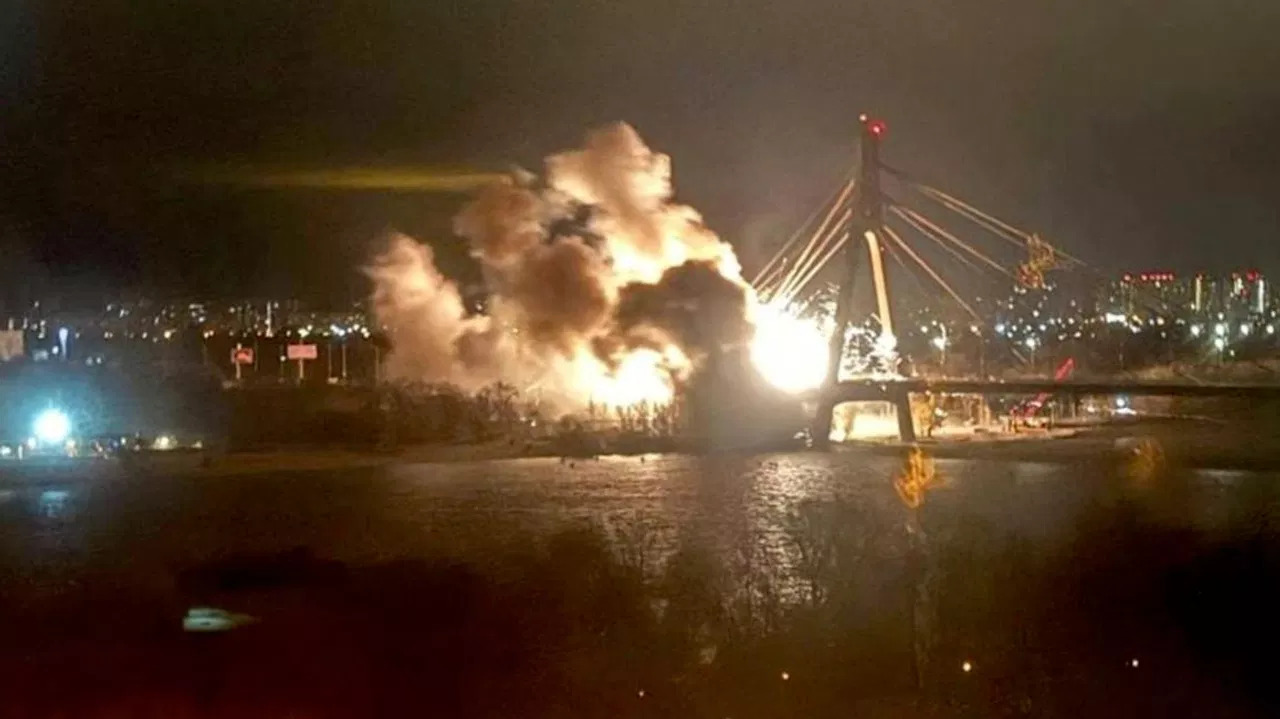
1. On the night of November 20, russia launched a combined attack on Ukraine using ballistic missiles and jet-powered drones. In Kyiv, the Podilskyi-Voskresenskyi, Darnytskyi, and Southern bridges were damaged, and traffic across the Podilskyi Bridge was partially restricted.
The strike on Kyiv's bridges was not only a military response but also a propaganda move by moscow in retaliation for the destruction of the Crimean Bridge. Through these attacks, the kremlin attempted to satisfy the russian public's demand for revenge over the destruction of their fallen symbol. The results of the attacks demonstrated the shortcomings of russian missile forces and the limited capabilities of Ukrainian air defense, but they did not amount to adequate revenge. Simply put, no bridge in Ukraine is a political symbol in the way the Crimean Bridge is for russians. Further strikes on Kyiv's crossings over the Dnipro River should be expected.
2. A trilateral meeting between Trump, Xi, and putin was held in Shenzhen on the sidelines of the APEC summit. The joint final declaration contained no mention of Ukraine and consisted of formal statements.
The final document of the meeting showed that there would be no Yalta-2. Quite the opposite: China demonstrated its interest in the existing world order architecture, dashing both Trump's and putin's hopes of forming a "trio" to redistribute spheres of influence around the world. China's interest in the meeting has become clear. In effect, Beijing used it to demonstrate its global leadership. Xi hosted putin and Trump not merely on Chinese territory, but as the host of the APEC summit, which allowed him to remain at the center of attention, place Trump and putin on an equal footing with the other guests, and determine the topics and terms of negotiations with them. At the same time, russia gained a major diplomatic advantage: Xi effectively recognized it as one of the world's three superpowers, while demonstrating how insignificant the issue of its aggression against Ukraine is at the level of great powers. This amounts to a kind of carte blanche for russia to wage war under the principle that might makes right, creating a negative backdrop for the negotiation process with russia. The very format of the "big three" is an obvious counterweight to the G7, which does not include russia. However, this format will most likely die with the end of Trump's political career. In other words, despite the unprecedented nature of the trilateral meeting between the leaders of the US, China, and russia, it brought the parties mainly short-term tactical advantages without producing any strategic effect.
3. On November 19, a meeting of the Coalition of the Willing was held in Berlin, attended by Volodymyr Zelensky and U.S. President's special envoys Steve Witkoff and Jared Kushner. According to Zelensky, it was decided that Europeans would participate in negotiations with moscow: the format would expand from trilateral to quadrilateral, with five European countries, plus the EU and NATO, representing Europe. On the same day, putin outlined his position. He called the deployment of any foreign troops in Ukraine unacceptable, questioned the point of Ukraine retaining the remaining approximately 10% of Donetsk region, and invited representatives of European countries to Moscow to clarify their positions on future peace negotiations.
We draw attention to putin's invitation to Europeans to come to moscow to clarify their positions. Not simply for consultations on neutral territory, but to moscow, and specifically to clarify their positions. In other words, the kremlin has not yet agreed to expand the trilateral format into a quadrilateral one and may block it if the Europeans' positions do not satisfy it. At the same time, it is demonstrating an interest in contacts with Europeans, but on its own territory and through separate talks. This is an attempt both to break out of diplomatic isolation in Europe, demonstrate who is in charge in Europe, and undermine European unity. Therefore, despite the Coalition of the Willing's decision in Berlin, it is too early to speak of a quadrilateral format. However, it is very important that Europe has agreed on a model for its future participation in the process, and the Americans have accepted it.
The negative aspect for Ukraine is that the future expansion of the negotiation track has not brought the parties' positions closer together; on the contrary, it has widened the gap between them. This could mean not an acceleration but a slowdown of the peace process and efforts to end the war.
4. On November 19, the State Duma passed the federal budget for 2027–2029 in its second reading. The 2027 figures are as follows: revenues of 43.3 trillion rubles, expenditures of 48.74 trillion rubles, and a deficit of 5.44 trillion rubles, or 2.2% of GDP. According to calculations by “The Moscow Times”, spending under the "national defense" budget item will increase by 32% in 2027, while the security and law enforcement sector combined will receive 44% of the entire state budget.
The budget adopted on November 19 formally enshrines the decision to continue the war for at least another three years. At the same time, the one-third increase in defense spending is being financed by cuts to healthcare and other social expenditures. Gradually, especially against the backdrop of hostilities spreading onto russian territory, this will intensify public dissatisfaction with the authorities. In response, putin's regime will be forced to tighten its grip, further inflaming the social and political climate in russia. The prolongation of the war without tangible results increasingly resembles the pre-revolutionary situation in the russian Empire after it entered World War I in 1914. Another couple of years of stalemate near Kramatorsk, alongside Ukrainian strikes on russia's economy, could end for putin the same way russia's entry into the war ended for Nicholas II.