
Political and military highlights of the past 24 hours. Europe and russia are betting on prolonging the war, while Trump simply doesn't care
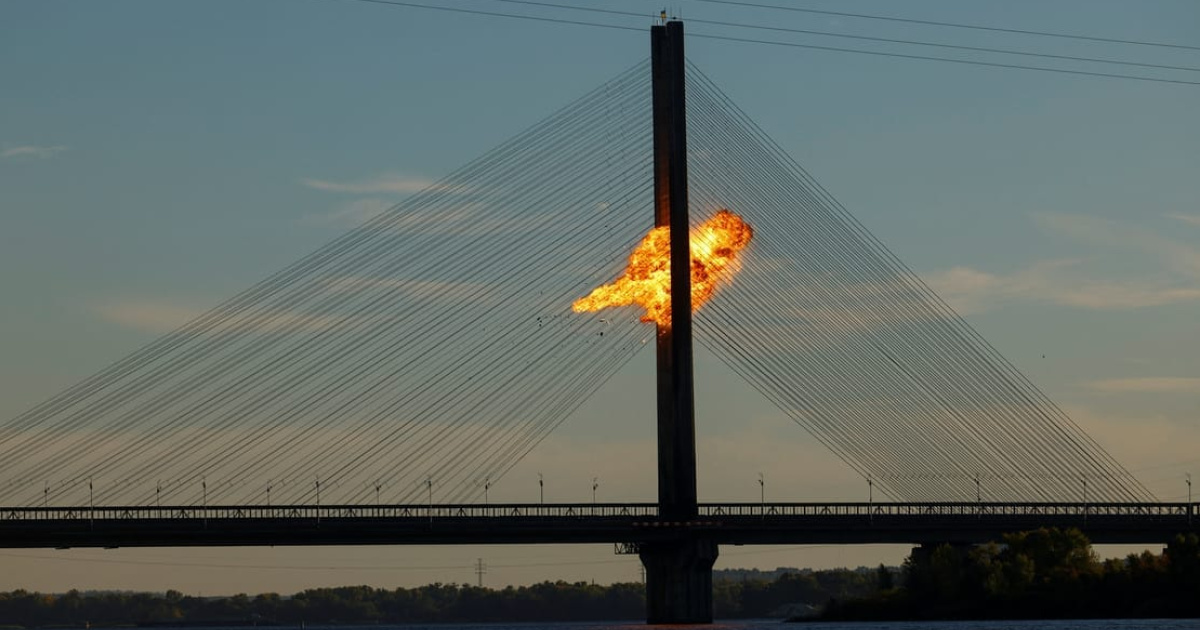
1. Yesterday, at around 11:30 p.m., Kyiv was attacked with ballistic missiles. According to mayor Vitalii Klychko, strikes were recorded on the Northern and Southern bridges across the Dnipro River.
The kremlin is shifting its attacks from power generation facilities to bridges across the Dnipro, attempting to split Kyiv and complicate military and civilian logistics ahead of winter. It is no coincidence that the strikes on two bridges in the capital took place immediately after the Ukrainian Armed Forces attacked the Crimean Bridge. Following this exchange of signals, attacks on bridges will either stop or, conversely, intensify. Everything will depend on the resources available to Ukraine's air defense and the readiness of Kyiv's transport infrastructure to replace its bridges with alternative crossings. In the event of the destruction of the Crimean Bridge, moscow has fewer alternative crossing options...
2. During the night of November 17, the Gazprom Neftekhim Salavat facility in Bashkortostan came under attack. One of its production units was hit, and a fire broke out. Around midnight, the Sadovaya substation (330 kV, Rosseti) in the Northern District of Kursk, which supplies electricity to approximately 400,000 residents and the Pribor and Schetmash factories, was attacked. Moscow mayor Sergey Sobyanin reported that more than 238 drones had been shot down.
Kyiv has maintained long-range pressure on russia for the second consecutive night. The strike on Salavat came on the same day that the facility was added to the EU sanctions list. For moscow, this means that the lost production capacity cannot be offset through either exports or insurance. By attacking the Sadovaya substation in Kursk, Kyiv is bringing to the aggressor's territory the "city without electricity" model that russia has been using in Ukraine since 2022.
3. Zelensky reported that Ukraine, the United States, and European countries had held remote consultations between their negotiating teams. According to the president, the talks were difficult, but the parties agreed to hold a new meeting in Berlin in the "coalition of the willing" format. More than 20 heads of state and government are expected to attend. The stated objectives are to secure funding for Ukraine's defense in 2027 and establish a unified position ahead of negotiations with russia. In an interview with Sky News Arabia on the same day, Zelensky said that the two-day trilateral talks in Abu Dhabi had resulted in an agreement in principle on a large-scale prisoner exchange, but kremlin representatives had refused to discuss a ceasefire, citing a lack of authority. The president emphasized that hostilities must cease before any discussion of territory. European foreign ministers also rejected russian proposals to revise the European security architecture and called for an immediate ceasefire as a priority. Meanwhile, putin's aide Yuri Ushakov stated that russia had not agreed to the participation of European representatives in the next round of negotiations with moscow.
On November 16, at the Foreign Affairs Council meeting, it became definitively clear that EU foreign policy chief Kaja Kallas, known for her anti-putin stance, would not be part of the European delegation. One diplomat described this as "simply impossible" because of the irritation she causes in the kremlin.
Moscow's refusal to discuss a ceasefire "due to a lack of authority" is a classic delaying tactic. The same applies to its ambiguous position on the participation of European representatives in the negotiations. Europeans voicing positions unacceptable to moscow before the negotiations even begin also serves to delay a peaceful settlement. Both russia and Europe are betting on the continuation of the war at least through the first half of 2027. At the same time, Kaja Kallas's exclusion from the European delegation because of the kremlin's hostility towards her demonstrates from the outset that Europe's approach to the negotiations will be that of a weak party rather than one exerting pressure on putin.
4. China's Ministry of Foreign Affairs confirmed yesterday that the first trilateral meeting between Xi Jinping, Trump, and putin would take place on November 19 in Shenzhen, as part of the APEC summit. The official agenda includes international security and strategic stability among the three nuclear powers. The White House announced that nuclear arsenal reductions would be discussed. However, according to Reuters, citing a U.S. administration official, Trump does not plan to raise the issue of the war in Ukraine, and a separate bilateral meeting with putin is also not planned.
The Shenzhen summit gives putin the image of an equal among the three nuclear powers, despite his war against a sovereign state. Trump and Xi are thereby legitimizing the trio's right to external aggression. It should be noted that, so far, only Xi has refrained from exercising this right. The fact that Ukraine is excluded from the agenda indicates that, for Trump, the killing of tens of thousands of people every month is not a reason to jeopardize his personal relationship with putin. Essentially, that is all one needs to know about the White House's policy towards Ukraine under Trump. At the same time, since the "Ukrainian issue" is existential for putin, all of moscow's initiatives at the trilateral summit should be examined in terms of their impact specifically on the war in Ukraine. The first such initiative is the meeting of the three leaders itself.
5. On November 16, acting head of the Zaporizhzhia Oblast Military Administration Mykhailo Semykin reported the completion of the search and rescue operation in Komyshuvakha: the deaths of 72 people had been confirmed, four were considered missing, and another four injured people remained in hospital. The strike was carried out on November 2, while people were receiving humanitarian aid. As early as November 7, Ukraine's Defense Intelligence identified those involved: the planning was attributed to Colonel Fyodor Zubakov, and four Su-34 aircraft and six pilots were involved in the attack.
Komyshuvakha is direct evidence for future war crimes proceedings. And the sooner this international mechanism is put into operation, the greater its impact will be on those who directly carry out criminal orders.