
Political and military highlights of the events of October 1 in Ukraine and around the world. A new level of escalation
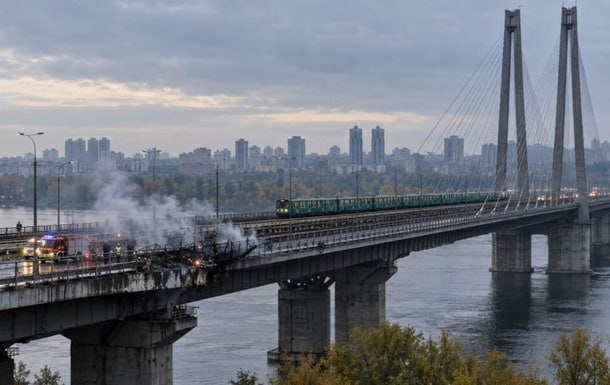
1. On October 1, russia attacked the Southern Bridge in Kyiv twice in one day. Two drones hit a support structure of the bridge as a metro train was passing: traffic and metro services between the two banks of the river were suspended for the first time during the war.
The strike on the Southern Bridge marks a qualitatively new level of escalation in the war. For the first time, russia deliberately attacked a major transport artery in Kyiv. Damage to bridges could paralyze traffic between the two banks of the Dnipro, dealing a greater blow to the capital's economy than power outages.
Ukraine's retaliatory strikes on russian bridges would be the most appropriate and relatively bloodless way to transfer the hardships of war directly to the russian population. It is important that russia was the first to take this step.
2. On October 1, Zelensky reported the first combat use of Ukraine's FP-7 tactical ballistic missile, as well as the start of its production.
The transition from drones and cruise missiles to Ukraine's own ballistic missiles marks a qualitative shift in the war. The question now comes down to how many of these weapons can be produced.
3. The General Staff of the Armed Forces of Ukraine released data showing that russia's losses in September amounted to 46,230 military personnel, 46% more than in January.
If these figures are accurate, russia's losses have approached 50,000 per month for the first time, a threshold that Ukrainian leadership has described as unsustainable. In the first eight months of 2026, russia signed 234,000 military contracts, compared with 260,000 during the same period in 2025. Since December 2025, russia's losses have regularly exceeded its recruitment numbers. This explains the pace of russia's offensive in Donbas. The 18,000 North Korean troops will not save the situation. However, launching another wave of mass mobilization would not be in putin's interests, given the existence of the U.S. “Hellish Sanctions Act”. This explains his statements about the uncertainty surrounding the timeline for capturing Donbas and the intensification of strikes on Ukraine's rear.
4. Speaking at a meeting of the Valdai Discussion Club, putin rejected the idea of a mutual cessation of long-range strikes, which Zelensky had been promoting. He acknowledged that Ukrainian strikes on oil refining facilities cost russia around 1% of its GDP, but said that the retaliatory campaign against Ukrainian infrastructure and logistics would continue.
Moscow considers the exchange of strikes advantageous to itself because Ukraine's energy system is more vulnerable than russia's oil refining industry. At the same time, the public admission that russia has lost around 1% of its GDP is a signal to russians explaining why their quality of life will continue to deteriorate. In other words, moscow is counting not on military gains, but specifically on the destruction of Ukraine's socioeconomic infrastructure. The situation could change in winter, after Middle Eastern oil prices stabilize, which could multiply the macroeconomic impact of Ukrainian strikes on russian oil refineries.
5. Ukraine and the European Commission have identified sources of funding to cover Ukraine's budgetary and defense needs through the end of 2026 and agreed to move as quickly as possible toward providing €45 billion for 2027.
Without EU funding, the Ukrainian government would already have faced a choice in November between defense spending and social payments. However, the wording “identified sources of funding” indicates a political agreement, not money that has already been received. Tying funding to reforms gives Brussels leverage over Zelensky, from anti-corruption institutions to the management of state-owned companies.
The move to discuss €45 billion for 2027 effectively means that the EU is planning for the war to continue for at least another year. This is also a serious signal to the kremlin, which is counting on Ukraine's socioeconomic exhaustion. It remains to be seen which side will be exhausted first.
6. Estonia has banned the transit of russian and Belarusian grain through its territory. Foreign Minister Margus Tsahkna explained the decision by saying that russia “attacks Ukrainian ports, blocks Ukraine's grain exports, and then looks for new routes” for its own exports. Latvia had previously announced a 300% tariff on such grain.
The Baltic ban on grain transit closes a route that moscow used to offset the blockade of Black Sea ports. This encourages it to reach an agreement on a “grain truce” in the Black Sea. If no such agreement is reached, russia will lose another source of revenue.
7. The Parliamentary Assembly of the Council of Europe unanimously declared the new russian State Duma illegitimate and called for the legal consequences of the “elections” in the occupied territories to be rejected, contacts with the Duma to be avoided, and sanctions to be imposed on russia's Central Election Commission and the organizers of the voting.
PACE's decision deprives russia of an instrument for legitimizing annexation through the “representation” of occupied territories in the State Duma. This is very important because it creates a legal basis for refusing to recognize the annexation of Ukrainian territories under any ceasefire scenario, even one unfavorable to Kyiv.
8. The Shevchenkivskyi District Court of Lviv sentenced 20-year-old Viacheslav Zinchenko to life imprisonment for the murder of former MP Iryna Farion, who called the residents of Donbas “biomass” and did not recognize russian-speaking people as Ukrainians. At the same time, the accused did not admit his guilt.
The weak evidence in this case makes the verdict purely political. This creates latent tension between Ukrainian nationalism and the russian-speaking segment of society, which will intensify when Ukraine returns to normal political life.
9. October 2 is the final deadline for residents of the Luhansk oblast, whose communities have been occupied since 2014, to submit applications for preferential long-term housing loans. However, applications for these loans were accepted only starting on September 23 (!).
The nine-day window for internally displaced people from the Luhansk oblast to apply for housing loans is an indicator that the region, physically lost in its entirety, is gradually disappearing from the system of state priorities as well. Essentially, it no longer exists for the state. Russia is physically destroying Donbas, while Ukraine is destroying it mentally and organizationally (language, history, socioeconomic ties). People are losing their connections to it and ceasing to be part of its structure. After de-occupation, both internally displaced people and refugees will have nowhere to return to: Donbas will become simply a territory with a “cursed past”. As a result, refugees abroad will have no incentive to return to Ukraine, while internally displaced people will become people whose lives include a part that has been “damaged” and rejected by their own country. These are millions of people! Some of them will also seek to build their lives abroad, further exacerbating Ukraine's demographic and labor crises.