
Political and military highlights of the events of September 22 in Ukraine and the world. Trump will definitely not impose “hellish sanctions” on russia before December
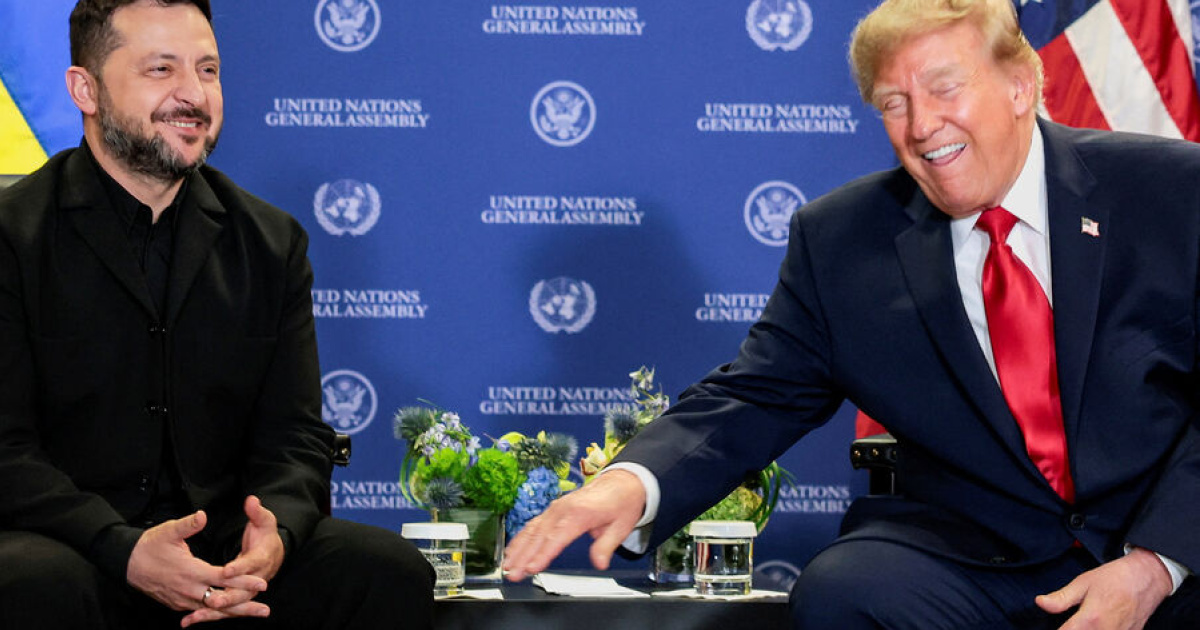
1. In New York, Volodymyr Zelensky held 40-minute talks with Donald Trump. Following the talks, Zelensky said that Ukraine was ready for a reciprocal energy truce: Kyiv would stop striking russian oil refineries and energy facilities if russia stopped striking Ukrainian power generation, heating and water supply. He separately emphasized that Trump had not demanded a unilateral halt to the strikes, although the U.S. side had raised the issue of fuel prices. Trump spoke about the possibility of ending the war before winter.
By agreeing to an energy truce but making reciprocity from moscow a condition, Kyiv shifts responsibility for its failure onto russia. This deprives Trump of the ability to pressure Kyiv. Moscow’s failure to agree to an energy truce, despite the deepening gasoline and budget crises in russia, indicates that the kremlin is relying primarily on the destruction of Ukraine’s energy infrastructure this coming winter.
2. Speaking at the opening of the high-level UN General Assembly, Trump recalled that he had signed the sanctions bill against russia adopted by Congress and said that, if necessary, he would have to impose them. The kremlin responded to the truce proposal through Dmitry Peskov: russia stands “for a lasting peace forever, not for a truce that essentially achieves nothing”.
Trump is deliberately keeping tariffs against buyers of russian oil as a deferred threat because their implementation at the current oil price of around $100 per barrel would hurt American consumers before hitting the kremlin. Accordingly, this mechanism definitely will not be used before the U.S. congressional elections in November. Moscow understands this, which is why the kremlin does not yet see the need to soften its conditions for ending military hostilities in Ukraine.
3. On September 22, the EU Council extended individual sanctions for undermining Ukraine’s territorial integrity for 36 months at once, instead of the usual six. At the same time, at the request of France and Slovakia, three individuals and one legal entity were removed from the list, including russian billionaires Alisher Usmanov and Mikhail Fridman.
The shift to a three-year sanctions renewal cycle deprives Budapest and Bratislava of the opportunity to blackmail the EU every six months. The price for this stability was two specific putin oligarchs. The risk of this decision is that it has created a precedent, and it will be easier to push through the next “technical” removals from the sanctions list. On the other hand, this is also a “window into Europe” that gives russian oligarchs at least a theoretical alternative of choice: with putin or in the civilized world.
4. Saudi Arabia has restored operations of the East-West pipeline, damaged by a Houthi attack, and is preparing to resume exports through Yanbu. At the same time, the flow of Saudi oil through the Strait of Hormuz has increased significantly. Iran said it was ready to restore normal traffic through the Strait of Hormuz within seven days if the United States reduced military pressure and eased the blockade of Iranian ports. As a result, Brent fell below the psychologically important $100 mark and closed at $99.25 per barrel.
The decline in oil prices simultaneously reduces russia’s potential revenues; eases inflationary pressure on the United States and Europe; and lowers the political cost of Ukrainian strikes on russian oil refineries for Trump. So far, the trend in the U.S.-Iran conflict has moved in a direction favorable to Ukraine. But Trump’s speech at the UN gives reason to think that stabilization in the Middle East is only a temporary factor and that escalation, which russia has an interest in, could occur at any moment.