
Political and military highlights of the events of September 6 in Ukraine and around the world. Talks in Kyiv and moscow
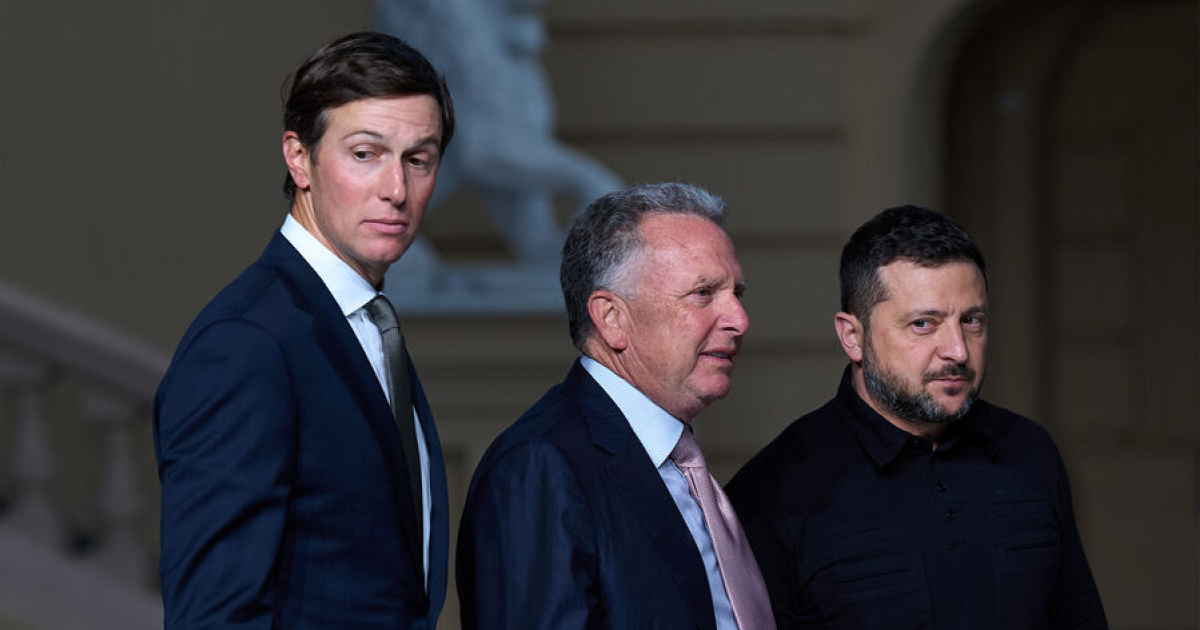
1.The main event of the weekend was the talks by Trump’s special envoys Steve Witkoff and Jared Kushner in moscow and Kyiv. The delegation included U.S. Treasury official Jean Lang, who oversees sanctions policy and separately met with putin’s special envoy Kirill Dmitriev.
The statements by all participants in the talks show that no breakthrough was achieved. Moscow’s position has not changed. Putin is confident in his military advantage on the frontline, and that is precisely why, for him, the negotiating process is a way of buying time to delay the introduction of new sanctions and a personal concession to Trump, who initiated the resumption of this process, rather than a search for a peaceful compromise.
Zelensky also outlined a fundamental framework: “The issue of Donbas is the issue of this war”. Following the meeting with the Americans, he allowed for the possibility that the war would continue through the winter and named the priorities of the “winter package” — air defense, support for the energy sector, and supplies of American liquefied gas.
The formula “the issue of Donbas is the issue of this war” is a fixation of the red line for both sides. Hence Zelensky’s shift in emphasis: “plan A” — diplomacy, “plan B” — Ukraine’s own drone interceptors and the winter resilience of the energy system. The emphasis of the talks was placed on plan B. This is an acknowledgment that Ukraine is entering its fourth winter of war, the outcome of which will depend on Kyiv’s ability to make its air defense effective.
In other words, a compromise is currently impossible, while the Trump administration is still not exerting the pressure on putin necessary for one. Accordingly, Trump also views this negotiating process as a tool for resolving his domestic political problems (the upcoming congressional elections) and an element of the geopolitical calculus (Iran, China). This is also indicated by such a detail of the Americans’ visit to moscow as the presence in the delegation of a U.S. Treasury official responsible for sanctions. Obviously, he discussed technical rather than political issues with Dmitriev. This means that sanctions are turning from an instrument of pressure into a bargaining chip in Trump’s negotiations with putin in Trump’s interests, but not Kyiv’s.
The involvement of Germany, France, and Britain in the second round is an attempt by Kyiv and Europe to balance this out by tying any agreements to European security guarantees and European money.
Essentially, these were not peace talks on Ukraine between Washington, moscow, and Kyiv, but two separate negotiating processes: talks between the U.S. and russia in moscow and talks between the U.S., Ukraine, and the EU in Kyiv.
The first brought no positive results for Ukraine. The second will help address Kyiv’s problems with air defense and energy during the winter period. The subject and essence of both negotiating tracks was not establishing peace, but the conditions for continuing the war.
2.The scandal surrounding the NABU and SAPO special operation “Carthage” has come close to the Prosecutor General. On September 6, a SAPO prosecutor stated in the High Anti-Corruption Court that Serhii Kropyva, an employee of the Prosecutor General’s Office whom NABU suspects of “covering for” illegal call centers, organized and coordinated renovations at Prosecutor General Ruslan Kravchenko’s house in Kozyn. Wiretap materials from January 26, 2026, record Kropyva discussing the installation of a generator and electrical specifications with Kravchenko, addressing him as “Boss”. In addition, according to the prosecution, Kropyva helped obtain a U.S. visa for the Prosecutor General’s wife and organized his birthday celebration in Madrid during an official trip to Spain. Kravchenko himself denies involvement in the call center case, while Kropyva has been suspended from his duties.
A series of corruption scandals involving people close to President Zelensky is creating a negative domestic and foreign policy backdrop for Kyiv’s efforts to conduct mobilization, obtain military and financial assistance from the West, and join the EU.
Moreover, this is already the third episode this year of a direct confrontation between the anti-corruption vertical and the law enforcement bloc subordinate to the president. What distinguishes the current case is that the suspicion is built around everyday services provided personally to the Prosecutor General — a construction that is the most difficult to disavow through procedural arguments. Any attempt by the office of the President to suppress the case administratively will hit EU funding precisely when it is needed for air defense and energy. Most likely, Zelensky will have to sacrifice Kravchenko, just as Chernyshov, Yermak, Mudra, and other people close to him were dismissed before.
3.The conflict between russia and Germany has sharply escalated. Russian Foreign Minister Sergey Lavrov said in an interview with propagandist Zarubin that Berlin’s actions were “the beginning of a real war”, while Chancellor Friedrich Merz “is actually declaring war on us”, adding remarks about “Nazi metastases”. The trigger was German decisions after Berlin officially accused russia of a hybrid attack at Leipzig Airport on September 1: in August, an FPV drone with explosives was discovered there near the wing of a Ukrainian An-124 transport aircraft.
The Leipzig incident shifted the center of gravity of the European debate: the issue is no longer about supporting Ukraine, but about protecting NATO’s own territory from sabotage. This is a beneficial shift for Kyiv — what previously had to be proven is now being articulated by Berlin itself, and German air defense assistance is ceasing to be a subject of domestic political bargaining in Germany.