
Zelensky named and detailed 20 points of a plan to end the war for the first time
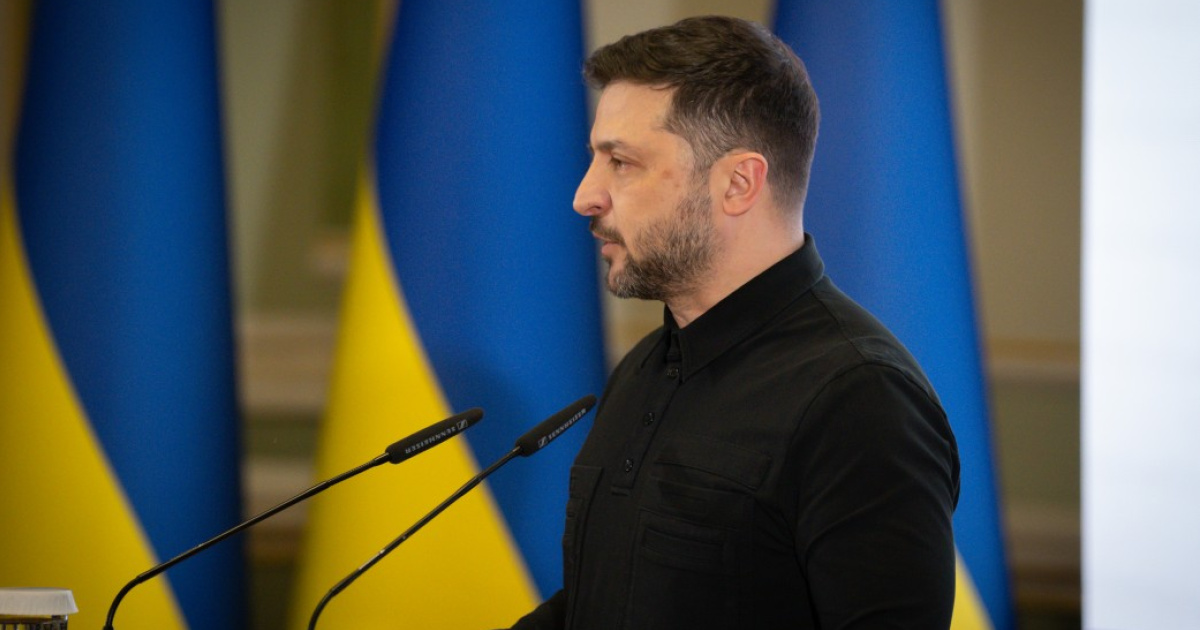
President Volodymyr Zelensky for the first time presented a version of a 20-point document between the United States, Europe, Ukraine, and russia and called it a “basic document on ending the war”. He said this at a meeting with journalists, Suspilne reports.
According to him, Kyiv is now awaiting a reaction to the discussed positions from the russian side.
“Then we will understand our next steps and possible time frames for certain decisions”, - the president said.
Also, according to Zelensky, Ukraine is now “ready for a meeting with the United States at the level of leaders to resolve sensitive issues”.
“Things like territorial issues need to be discussed at the level of leaders”, - Zelensky emphasized.
“If we speak specifically about these 20 points that exist today, this is a framework document that has gone through significant evolution. It is the document that previously began with 28 points (this refers to the version of the peace agreement proposed by the United States, which, according to media reports, was allegedly supported by Donald Trump — ed.). There were many different rumors and a lot of groundwork, many meetings and many hours of talks. As a result, today there is this document, which has this form — it is a draft. This is not yet a document agreed upon by the parties, but it already has a certain formed logic of how it is proposed to end the war”, - the president added.
What the document provides for at this stage:
Point 1: Ukraine’s sovereignty will be reaffirmed. The document states that Ukraine is a sovereign state, and all signatories to the agreement confirm this with their signatures.
Point 2: This document represents a full and unconditional non-aggression agreement between russia and Ukraine. To maintain long-term peace, a mechanism for monitoring the line of contact will be created using space-based unmanned monitoring, as well as an early warning mechanism for violations.
Point 3: Ukraine will receive strong security guarantees.
Point 4: The size of the Armed Forces of Ukraine will remain at 800,000 in peacetime.
Point 5: The United States, NATO, and European signatory states will provide Ukraine with security guarantees that will reflect Article 5.
If russia invades Ukraine, in addition to a coordinated military response, all global sanctions against russia will be restored. If Ukraine invades russia or, without provocation, opens fire on the territory of russia, the security guarantees will be considered invalid. If russia opens fire on Ukraine, the security guarantees will come into force. The United States will receive compensation for the security guarantees. According to Zelensky, this point has now been crossed out: “We simply do not understand what this means, and we are raising this issue”. Bilateral security guarantees are not excluded by this agreement. “We are talking about the possibilities of our bilateral agreements with 30 countries; we want these possibilities to remain. These are the countries of the Coalition of the Willing — 30 countries, including Europe, Canada, and Japan, which are ready in one form or another to be with us in guaranteeing security”, - Zelensky clarified.
Point 6: russia will закрепить a policy of non-aggression toward Europe and Ukraine in all necessary laws and all necessary ratification documents, including ratification by an overwhelming majority of votes in the State Duma (a U.S. proposal).
Point 7: Ukraine will become a member of the European Union within a specifically established timeframe, and Ukraine will also receive short-term privileged access to the European market. At the same time, the exact dates of Ukraine’s accession to the EU are currently the subject of bilateral discussions between the United States and Ukraine, so far without European confirmation.
Point 8: A robust global development package for Ukraine will be approved (to be defined in a separate agreement on investments and future prosperity). In particular, it will provide for:
The creation of a Ukraine development fund to invest in fast-growing sectors (technology, data centers, AI). The United States and American companies will cooperate with Ukraine and jointly invest in the restoration, development, modernization, and operation of Ukraine’s gas infrastructure. Joint efforts will be made to reconstruct territories affected by the war with the aim of restoring, rebuilding, and modernizing cities and residential areas. Infrastructure development. Extraction of minerals and natural resources. The World Bank will prepare a special financing package to ensure the acceleration of these efforts. A high-level working group will be created, including the appointment of a leading global financial leader as a prosperity administrator to organize the implementation of the strategic recovery plan and maximize opportunities for future prosperity.
Point 9: Several funds will be created to address issues of restoring the Ukrainian economy, reconstruction of damaged areas and regions, and humanitarian issues. The goal is to attract 800 billion dollars through equity capital, grants, debt obligations, and private sector contributions to help Ukraine fully realize its potential.
The United States and European countries will create a capital and grants fund with a target size of 200 billion dollars for transparent and effective investment in Ukraine. A wide range of capital investments and other financial instruments will be applied for the post-war recovery of Ukraine. Global recovery institutions will use mechanisms to strengthen and facilitate these efforts. Ukraine will implement the world’s best standards to attract foreign direct investment. Ukraine retains the right to compensation for damages incurred.
Point 10: After the conclusion of this agreement, Ukraine will accelerate the process of concluding a free trade agreement with the United States. At the same time, the United States wants parity in the FTA both for Ukrainians and for russians.
Point 11: Ukraine confirms that it will remain a non-nuclear state in accordance with the Treaty on the Non-Proliferation of Nuclear Weapons.
Point 12: The Zaporizhzhia Nuclear Power Plant will be operated jointly by three countries — Ukraine, the United States, and russia. The United States proposes to divide control evenly, with Americans acting as the main manager of this joint enterprise. The Ukrainian proposal is different: the Zaporizhzhia plant will be a joint enterprise involving the United States and Ukraine: 50 to 50. But 50% of the electricity produced goes to Ukraine, and the other 50% to the United States, which independently determines its distribution.
Point 13: Both countries commit to implementing educational programs in schools and throughout society that promote understanding and tolerance toward different cultures, eliminate racism and prejudice. Ukraine will implement EU rules on religious tolerance and the protection of minority languages.
Point 14: Territorial distribution.
russia withdraws its troops from the Dnipropetrovsk, Mykolaiv, Sumy, and Kharkiv oblasts for this agreement to enter into force.
Option A: In the Donetsk, Luhansk, Zaporizhzhia, and Kherson oblasts, the line of troop deployment as of the date of this agreement is the de facto recognized line of contact. A working group convenes to determine the movement of forces necessary to cease hostilities, as well as to define the parameters of potential future special economic zones.
Option B: A potential free economic zone on the territory of Donbas is being discussed — for its approval, Ukraine is ready to hold a referendum in the territories under its control. But the vote will concern support for the entire treaty, not only the clause on the FEZ. If a decision is made, a separate agreement will be concluded between Ukraine, the United States, and russians, which will determine the status of the special economic zone.
Point 15: After agreeing on future territorial arrangements, both the russian federation and Ukraine undertake not to change these arrangements by force.
Point 16: russia will not hinder Ukraine from using the Dnipro River and the Black Sea for commercial activities. A separate maritime agreement and access agreement will be concluded, covering freedom of navigation and transportation. The Kinburn Spit will be demilitarized.
Point 17: A humanitarian committee will be created to resolve outstanding issues.
All prisoners of war, including those convicted by the russian system since 2014, will be exchanged on an all-for-all basis; all civilian detainees and hostages, including children and political prisoners, will be returned; measures will be taken to address the problems and suffering of victims of the war.
Point 18: Ukraine must hold elections as soon as possible after signing the agreement. First — presidential elections: the Rada must develop and vote on a mechanism for how they can be held before the lifting of martial law restrictions. Then — parliamentary and local elections.
Point 19: This agreement will be legally binding. Its implementation will be monitored and guaranteed by the Peace Council chaired by President Trump. Ukraine, Europe, NATO, russia, and the United States will be part of this mechanism. Sanctions will be предусмотрены for violations.
Point 20: After all parties agree to this agreement, a full ceasefire will immediately enter into force.