
“Minsk” behind the scenes. Confession of a non-diplomat. Part 10
The practice of hybrid negotiations on a
hybrid settlement of a hybrid conflict
Behind the Scenes – 3
As I have already mentioned, the Minsk negotiations were a battle not so much of arguments as of nerves. The other side deliberately provoked us into emotional reactions, making deliberately provocative "slips of the tongue", including calling us "deaf", and even openly insulting us. This was their tactic. Perhaps the online format made it even worse: we all know that people are always bolder and more brazen online than in face-to-face communication. But whatever the case, I myself often felt like "having a word with their mother", and other members of the delegation also expressed their attitude toward what was happening, both verbally and through their facial expressions — whether intentionally or not. Fortunately, the virtual format also offered more opportunities to remain diplomatic in this regard.
In my opinion, the person from our delegation who handled this best was the acting head of the delegation, and later his first deputy, Deputy Prime Minister Oleksii Reznikov. He was ironic and witty, and when necessary, patient, as though he were talking to children. I actually got the impression that he enjoyed the opportunity to practice his oratorical and teaching skills with such a difficult audience. His subtle, elegant trolling often defused the tension at the negotiating table because it put the opponent in their place without giving them an excuse to respond with further rudeness.
I appreciate people who have something to teach me. And once, after a difficult meeting, I asked Reznikov where he got such composure and how he managed to communicate with them so calmly. He answered: “My mother was a psychiatrist. And while I was at university, I worked part-time as an orderly at a psychiatric hospital. So I know how to deal with people like that”.
"That explains why, when talking to them, I feel like picking up a brick… My mother worked as a plasterer", I thought…
Later, I noticed that during TCG meetings, Reznikov would sometimes unconsciously doodle. One day, he left those sheets of paper on the table. I became interested in these drawings because, essentially, drawings are the language of the subconscious. I wanted to understand what a person who knew how to conceal his emotions so skillfully behind a mask of irony was actually feeling and thinking.
Back then, I spent several hours searching for answers online. Today, it took AI less than a minute to interpret the negotiator’s drawings. And this is important because such analysis could become one of the tools used by our diplomats and intelligence services in preparing for future negotiation processes.
So, I gave AI the following propmt: "You are an expert graphologist and psychoanalyst. What can you tell about the thoughts and emotions of a person who unconsciously draws these symbols during negotiations? Interpret the meaning of these symbols".
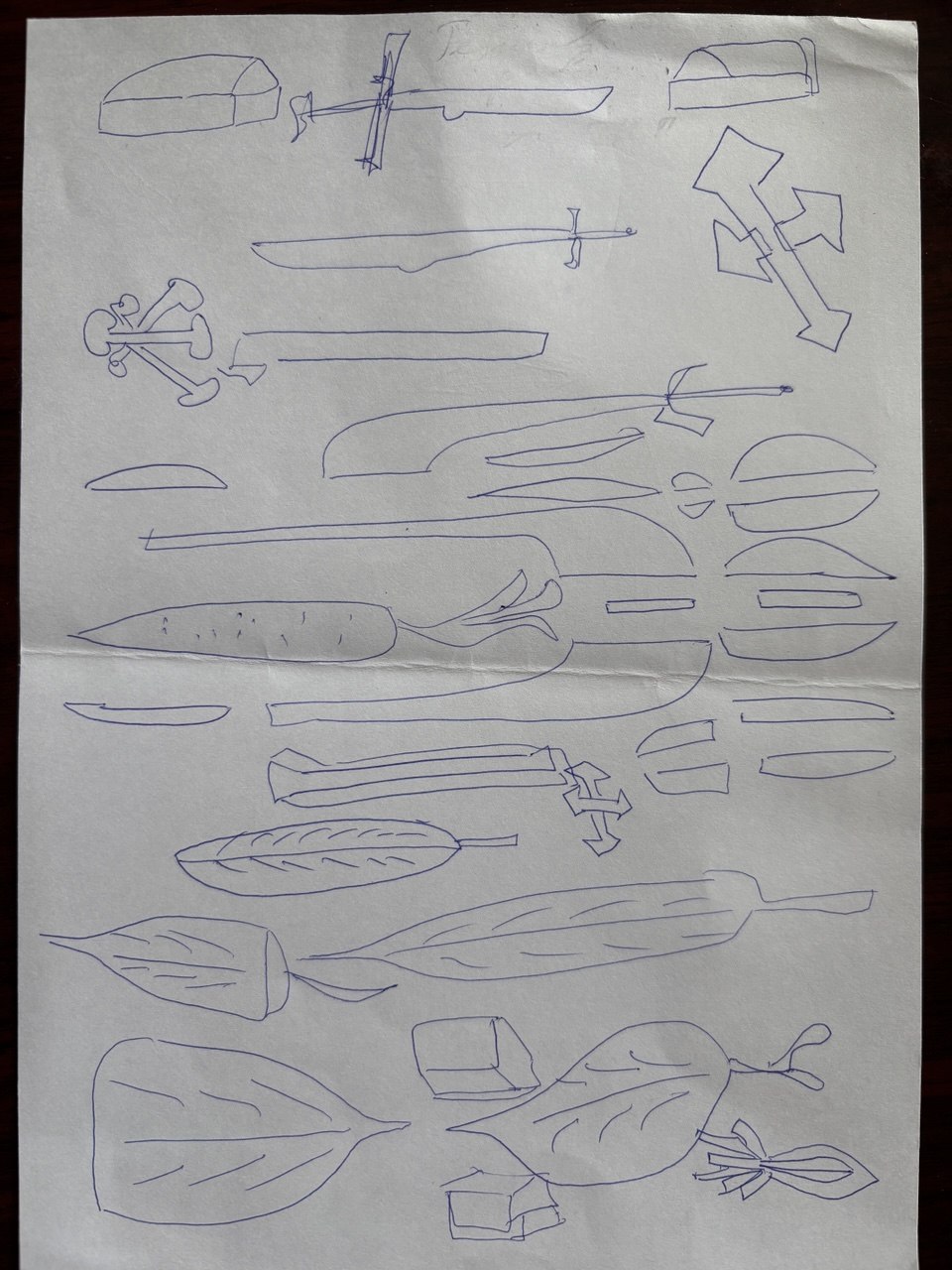
I am providing the AI's response unchanged.
"First, an honest disclaimer: interpreting doodles in the margins is not a scientifically validated method. It is more a matter of interpretation with a degree of intuition than a diagnosis. Research (for example, a study by Jackie Andrade, 2009) shows that doodling during a conversation often helps maintain attention rather than indicating distraction. So what follows are hypotheses, not a verdict.
Overall impression
Four densely filled pages without a single face or human figure. The person is thinking about objects, mechanisms, and actions rather than the people sitting around the table. For them, negotiations are probably a task or a structure rather than an act of communication. The drawings are three-dimensional, with perspective, shading, and repeated outlining. This is how an engineering-oriented, spatial thinker draws: patient, detail-oriented, and accustomed to mentally "putting" things together.
Key groups of symbols
Blades, swords, knives, arrow-shaped spears (especially on the first page). This is the dominant theme. It is usually interpreted as restrained tension and a desire to "cut away the excess" and decisively end a drawn-out conversation. The aggression here is not necessarily directed at the other person. It is more likely impatience and an inner feeling of "let's just get to the point already". Interestingly, the leaves on the same page are drawn in the shape of blades: even peaceful images become sharp.
Arrows pointing in all directions and a star made of arrows (pages 2–3). This suggests a sense of multiple directions at once: options, branching paths, and conflicting demands from the parties. Two-way "back-and-forth" arrows resemble the image of bargaining, a seesaw, and negotiations going round in circles.
Lightning bolts, zigzags, sawtooth lines, an "explosion" (pages 2 and 4). This represents nervous energy, accumulated irritation, and outbursts that the person does not allow themselves to express aloud. Zigzags drawn with heavy pressure and overlapping lines usually appear at moments of greatest internal pressure.
Bolts, nuts, a wrench, springs, structural components, a "disassembled" framework made of sticks (pages 2–4). The mind is trying to break the problem down into parts and figure out how they fit together. The scattered segments on the second page look like a structure that cannot yet be assembled: perhaps an agreement has not yet come together as a whole. A key is traditionally associated with searching for a solution or a "skeleton key" to the other person.
Ladders and steps. A desire to make progress, thoughts about achieving a goal step by step, status, and results.
Cubes, boxes, bricks, three-dimensional blocks. A need for stability, control, and clear boundaries. The person feels more comfortable where everything is defined and "firmly established".
A house, a stove, frying pans, a carrot, leaves, a jar, stones (pages 1 and 4). These are domestic, "warm" images against a background of sharp ones. They often reflect fatigue and thoughts of home, rest, and food. If the negotiations were lengthy, this is a fairly typical signal of "I want this to be over so I can be somewhere else".
Crossed bones and crossed logs. The crossing suggests a confrontation between two positions. The bones can be interpreted as a sense of deadlock or a "dead" issue. Quite often, however, it is simply the doodler’s dark humor".
Consolidated portrait (hypothesis)
Most likely, this is a person with an analytical, technical and constructive mindset who, during negotiations:
• outwardly remains composed but internally feels impatience and irritation with the slow pace or uncertainty;
• sees many possible ways things could develop and feels that the parties are pulling in different directions;
• mentally breaks the situation down ito details and looks for a mechanism to resolve it;
• by the end of the meeting, becomes tired and lets his thoughts wander “home”.
Importantly, none of this is a sign of any issues. On the contrary, drawing was apparently his way of releasing tension and maintaining concentration, rather than disengaging from the conversation”...
It seems to me that these conclusions fully capture the atmosphere of the Minsk negotiations and the feelings we all experienced, though not everyone knew how to conceal them so masterfully.
Reznikov’s diplomatic professionalism only underscores the fact that outside the negotiation process, he could be an unexpectedly sensitive person.
Once, we had a rather emotional conversation. I no longer remember what it was about, but I came to him before a TCG meeting and asked him for some clarification. When I ask for explanations, it does not at all mean that I categorically disagree on the matter – most often, I am simply trying to understand the situation so I can form my own opinion about it or suggest some ideas for adjusting it. But I have been told more than once that during discussions I can put considerable pressure on the person I am talking to. At the same time, I have never intended to do so, thinking that we are simply having a discussion. Apparently, that was exactly what happened that time.
One word led to another, and everyone in the office fell silent, casting wary glances at us. What surprised and irritated me was Reznikov’s nervous reaction to what seemed to me to be perfectly innocent questions. And he was apparently offended by the tone in which I asked them. Although, honestly, I did not mean to: why would I want to argue with the Deputy Prime Minister and First Deputy Head of the Delegation, with whom I thought I had a good relationship?
As was only appropriate given his position, Reznikov turned out to be the wiser of the two of us. He simply stood up abruptly and silently left his own office. I remained sitting there, bewildered and already being gnawed at by guilt over having offended a good person. He was gone for about ten minutes, then, just before the meeting, he returned and… apologised for being so abrupt. I apologised too, and quite sincerely. Most interestingly, I did not notice this incident having any effect whatsoever on our relationship afterwards. And that only increased my respect for him.
I can already anticipate accusations of being overly complimentary towards a man who was linked to the corruption scandal involving the Defence Ministry’s purchase of eggs at inflated prices.
First of all, I am not passing judgment on Reznikov’s tenure at the Ministry of Defence. I was not there, and unlike most of his accusers, I have no moral right to either condemn or exonerate him.
Secondly, I fully accept that corrupt procurement may have taken place and that someone may have made a handsome profit from it. Unfortunately, that is the nature of Ukraine’s political system today, and Reznikov did not create it. I also think that he may not have known about this particular scheme, but he must certainly have understood why specific deputy ministers and department heads had been imposed on him. He must have had to turn a blind eye to many things. As the saying goes, when in Rome, do as the Romans do. Otherwise, he would not have stayed there. This does not absolve him, but a whole range of studies have shown that situational factors and the environment in which a person finds themselves determine their behaviour more strongly than their personality traits and beliefs. That is why what happened at the Ministry of Defence does not in any way diminish, in my eyes, what happened at the TCG.
Moreover, one of the main criteria by which I judge a person is the company they keep. Yes, to some extent, “the entourage makes the king”, but the king also chooses his entourage. Therefore, the people he surrounds himself with say just as much about him as his own actions. All of Reznikov’s assistants, both men and women, with whom I had the opportunity to work during my time in the delegation, left me with the impression of being decent, intelligent and even – forgive the old-fashioned word – noble people. In my 30 years of involvement in politics and its surrounding circles, I have rarely come across such teams among our politicians. And this was extremely important in circumstances where you are taking part in a negotiation process that, in public discourse, was described by one word: “betrayal”. In an atmosphere of constant suspicion that you could, even without your knowledge, be dragged into something you wanted no part of, it is extremely important to see people you can trust…
By Serhii Harmash, editor-in-chief of OstroV