
New government: Fedorov's dismissal, conflict with Syrskyi, and the future of Zelensky's chief manager
When the government changes in Ukraine, the main political story is usually the name of the new prime minister. It is around that person that discussions unfold about the future course of the Cabinet of Ministers, possible reforms, and the new balance of power within the government. This time, everything happened differently.
The new prime minister, Serhii Koretskyi, almost immediately disappeared from public attention. Changes in the composition of the Cabinet, reshuffles among ministries, and new appointments also failed to become the subject of heated political debate. The main topic after the formation of the government became the person who did not join it.
Mykhailo Fedorov remained the biggest personnel intrigue until the very end. According to Ukrainian media reports, at different stages of the negotiations he was considered a possible prime minister or a deputy prime minister with expanded powers. In the end, President Volodymyr Zelensky did not include him in the new government at all.
It was this decision that caused the greatest public reaction. Discussions about the reasons for the dismissal of one of the country's most popular government members erupted on social media, military personnel and volunteers openly expressed their support for him, and protests took place in various cities across Ukraine. For Ukrainian politics, this is an unusual situation: for the first time in many years, a personnel decision concerning an individual minister overshadowed the appointment of a new prime minister.
According to OstroV's sources in the Verkhovna Rada, the final decision regarding Fedorov was made literally in the last hours before the nominations were submitted to parliament.
"If someone had said a week before the vote that the main topic after the formation of the new government would not be the prime minister but Fedorov, no one would have believed it. But that is exactly what happened. Until the very end, no one could believe that Zelensky would remove Fedorov. The problem is not even that he was dismissed from the Ministry of Defense, but that no other position was found for him. Offering him a role as a presidential adviser is almost an insult after so many years of working together and even friendship. Mykhailo is deeply offended, and he is not hiding it", - said one representative of the parliamentary majority.
The Office of the President had to change its plans
Just a few weeks earlier, the personnel scenario had looked completely different. According to OstroV's sources within the government team, then–Prime Minister Yuliia Svyrydenko was expected to leave the government and become Ukraine's ambassador to the United States.
Such an appointment seemed entirely logical. In recent years, Svyrydenko had been one of Ukraine's key negotiators with its Western partners, while the Office of the President was seeking to relaunch political dialogue with the United States. According to an OstroV source in the Verkhovna Rada, this was still considered the primary scenario at the beginning of July.
"Everyone assumed that Svyrydenko was going to Washington D.C., and that the government would then be formed around the new prime minister. But just a few days later, everything started to change", - the publication's source said.
According to OstroV's sources, for unknown reasons Svyrydenko refused to follow that scenario.
However, the story surrounding the U.S. embassy only accelerated the process. According to the publication's sources, the Office of the President had already been increasingly inclined to replace the head of government. The criticism was aimed not so much at the Cabinet's performance as at the prime minister's leadership style.
"Svyrydenko never became an independent political figure. Virtually every important decision was coordinated with the Office of the President. At some point, the question arose: if all the key decisions are being made there anyway, then why is such a prime minister needed?" - an OstroV source claimed.
Another source within the Servant of the People faction said that the president had long been looking for an opportunity to renew the government's leadership, and appointing Svyrydenko as ambassador to the United States was supposed to be a politically convenient way to conclude her tenure in the Cabinet.
"The idea was to offer her a politically honorable position. That would have avoided talk that she was being dismissed because of dissatisfaction with her performance", - the source explained.
No final decision has yet been made regarding Ukraine's new ambassador to the United States. According to OstroV, among the candidates still being considered by the Office of the President is National Security and Defense Council Secretary Rustem Umerov, who is expected to leave that position in the near future. At the same time, the publication's sources emphasize that the president has not yet made a final decision.
Koretskyi: the prime minister overshadowed by Fedorov
After the situation surrounding Svyrydenko was finally resolved, the president proposed Serhii Koretskyi to head the government. For the broader public, his appointment came as a surprise, although within government circles his candidacy had been discussed for several months.
Before entering politics, Koretskyi worked in the private sector, headed the WOG filling station chain, and later managed the state-owned companies Ukrnafta and Naftogaz. According to OstroV's sources, it was his experience as a crisis manager, rather than his political career, that became the main argument in his favor.
"What is needed now is not a politician but an effective manager. The country needs someone who can guide it through the most difficult period — the autumn and winter season", - one of the publication's sources said.
Sources describe preparations for winter as the new prime minister's main task. This includes ensuring a stable heating season amid russian strikes on energy infrastructure, building up gas reserves, coordinating the energy sector's operations, and working with international partners on energy imports and funding for critical infrastructure.
However, even after the new head of government had been selected, personnel reshuffles continued. According to OstroV's sources, one of the first candidates considered for the post of defense minister was then–Interior Minister Ihor Klymenko. However, he refused to move to the Ministry of Defense, forcing the Office of the President to urgently look for another candidate.
At the same time, the Interior Ministry had already been preparing for his departure. According to the publication's sources, the ministry was expected to be headed by National Police Chief Ivan Vyhivskyi (which ultimately happened). As a result, the personnel reshuffle effectively stalled: the new interior minister had already been chosen, while Klymenko, after declining the defense minister position, was left without a new appointment.
"We literally had to look for a new option on the fly. That's how the idea of appointing him as Secretary of the National Security and Defense Council came about", - an OstroV source within the parliamentary majority said.
In the end, Klymenko is expected to become Secretary of the National Security and Defense Council. According to the sources, this decision was made only at the final stage of shaping the new configuration of power.
Overall, the new Cabinet of Ministers has largely preserved continuity. Most key ministers have remained in their positions, some government members have received new portfolios, and several ministries have been reorganized. This suggests not a change in political course but rather an attempt by Zelensky to strengthen control over the executive branch and reinforce specific areas of the government's work.
Why Fedorov became the main intrigue
While most personnel decisions in the new government were more or less predictable, there was complete uncertainty surrounding Mykhailo Fedorov until the very end. According to OstroV's sources in the Verkhovna Rada, his name was mentioned most often during closed-door consultations.
"At one point, it felt like decisions had been made on everyone except Fedorov. The options were changing literally every day", - one representative of the parliamentary majority said.
Over the years of working on Volodymyr Zelensky's team, Fedorov became one of the most influential members of the country's government. After successfully leading the state's digital transformation, he headed the Ministry of Defense, where he focused on developing defense technologies, expanding drone production, digitalizing processes, and more actively involving the private sector in weapons manufacturing.
According to OstroV's sources within the Servant of the People party, it was then that he effectively stopped being a minister in the traditional sense.
"He was no longer seen as the head of a single ministry. He had become a separate decision-making center with his own team, direct access to the president, and the backing of the technology community", - the source said.
As Fedorov's political influence grew, so did his public support. He was increasingly mentioned among the possible candidates for the country's highest offices after the war, and officials within the government began openly discussing his political future.
"He had already become a politician of national stature. Many saw him as one of the potential leaders of the next generation of the president's team", - an OstroV source within the parliamentary majority said.
For this reason, several scenarios for his future were considered during the formation of the new government. At various stages of the consultations, Fedorov was mentioned as a candidate for prime minister, his possible transfer to the Office of the President was discussed, and he was also considered as a potential leader of the presidential party's electoral list after the war.
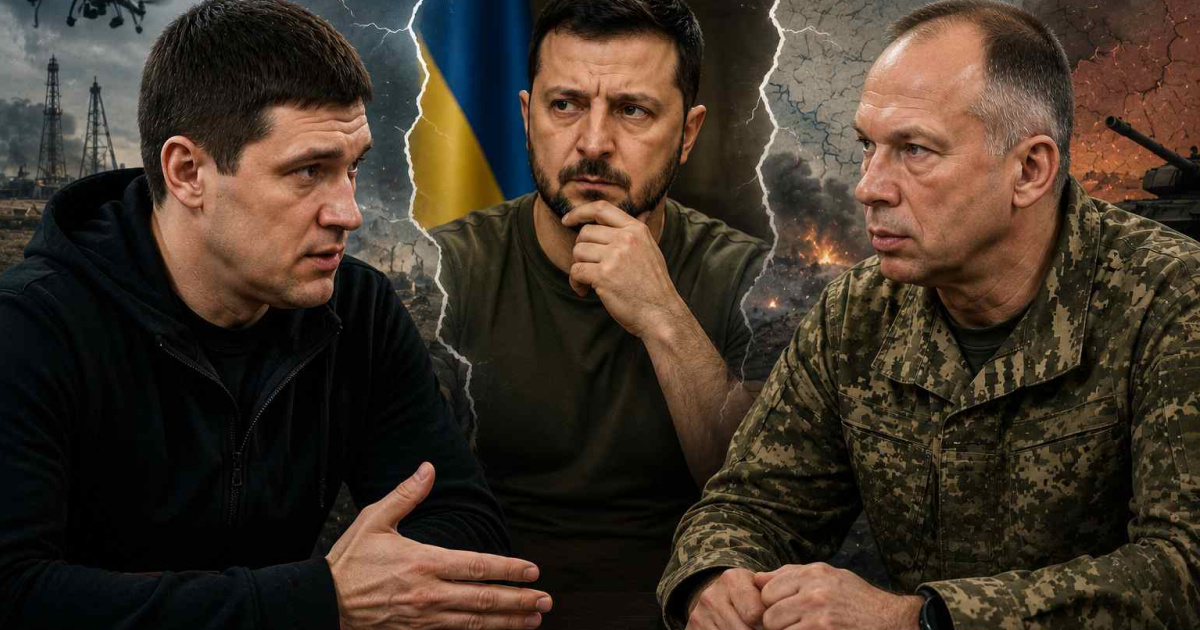
However, the closer the process came to a final decision, the more apparent it became that the issue was no longer finding Fedorov a new position, but rather the conflict that had gradually been building over recent months between the Ministry of Defense and the military command.
A conflict of two approaches
According to OstroV's sources in the Verkhovna Rada, the key reason why the Office of the President ultimately abandoned the idea of keeping Mykhailo Fedorov in the government was the conflict that had steadily escalated in recent months between the Ministry of Defense and the General Staff.
Little was said about it publicly, but within the government, serious disagreements between Fedorov's team and the then Commander-in-Chief of the Armed Forces of Ukraine Oleksandr Syrskyi were increasingly being discussed.
"It wasn't a clash of personalities. It was a clash between two systems of governance", - one of OstroV's sources within the parliamentary majority said.
According to the sources, Fedorov sought to bring to the defense sector the principles that had previously worked in the Ministry of Digital Transformation: rapid decision-making, minimal bureaucracy, digitalization of processes, and broader involvement of private businesses in weapons production.
Among his priorities were the development of drone programs, reforming the procurement system, and reducing the time between the emergence of a need on the front line and the adoption of decisions.
"His logic was simple: the war is changing so quickly that the state cannot operate according to peacetime rules", - the source explained.
The General Staff viewed the situation differently. It believed that overly rapid changes could disrupt the already established system of military command, and that key decisions should primarily be made with the operational situation in mind. Disputes arose over the distribution of powers, the development of drone programs, and the implementation of new digital tools.
"Each side believed it understood better how the system should operate. As a result, more and more decisions began requiring Presidential Office's intervention", - the publication's source said.
According to another source within the government team, the president spent a long time trying to find a compromise between the two centers of influence. However, over time it became clear that the disagreements had become systemic.
"The president needs a unified chain of command for managing the war. When systemic disagreements build up between the Ministry of Defense and the General Staff, sooner or later a political decision has to be made", - the source said.
Notably, while commenting on the personnel changes, Volodymyr Zelensky effectively acknowledged for the first time in public that there were problems in the interaction between the Ministry of Defense and the military command. The president stated that effective management of the defense sector requires full coordination among all its components, and that any internal disagreements during wartime are unacceptable.
During a press conference following the end of his tenure as defense minister, Fedorov himself spoke in greater detail about the conflict with the military leadership.
"We were faced with the fact that the initiatives we proposed started being blocked, and Syrskyi, despite all the problems we discussed today, is not prepared to speak openly about those problems face to face. Instead, he is willing to attend meetings in person, weave intrigues, and think that someone has commissioned some kind of media campaign... This led to the point where he effectively issued an ultimatum. And instead of figuring out how to defeat russia asymmetrically, he figured out how to divide the country. And that is the major problem", - he said.
However, OstroV's sources insist that the conflict with Syrskyi was only part of a broader story.
According to them, the Office of the President was paying increasing attention to how Fedorov's own political influence was evolving. Over the course of several years, he had become one of the most influential members of the president's team, and his name was increasingly mentioned as a potential future rival to the incumbent head of state.
"At some point, he became a politician who was perceived separately from the government. That doesn't mean he was a rival to the president. But his political weight was objectively growing. Zelensky doesn't like that", - OstroV’s source within the Servant of the People party said.
That is why, during personnel consultations at the Office of the President, mutually exclusive scenarios for his future were considered simultaneously: from appointing him prime minister to moving him to the Office of the President or even appointing him to head Ukroboronprom.
Fedorov's story is not over yet
Despite his dismissal, Mykhailo Fedorov, according to OstroV's sources, is not leaving the president's team. On the contrary, the Office of the President is interested in retaining one of Zelensky's most successful managers, although it has not yet decided in what capacity he will continue his work.
Immediately after the decision on the new government was made, the president offered Fedorov a position as an adviser in the Office of the President. However, that option has not become the final decision.
"There was a discussion about the adviser position. But that is not the final arrangement. Different models are currently being considered", - a source within the Servant of the People faction said.
According to OstroV's sources, the Office of the President is currently considering creating a separate position or even a new institution that would coordinate the development of defense technologies, the digital transformation of the security sector, and the implementation of innovations. The idea is to make the best possible use of Fedorov's managerial experience while at the same time avoiding a repeat of the conflict that emerged between the Ministry of Defense and the General Staff.
The president is not interested in losing one of his most effective managers, but the final format of his future role has not yet been determined.
"No final decision has been made yet. On the one hand, the relationship between Zelensky and Fedorov will no longer be what it once was. On the other hand, the president does not want to lose him. They are now looking for a role in which he can be of the greatest benefit while at the same time avoiding overlap with the areas where conflicts previously arose. One option is to create a position specifically for him", - an OstroV source within the government circle said.
Thus, the main personnel intrigue of the current government reshuffle remains unresolved. While the new prime minister and the composition of the Cabinet have already been decided, the president's team appears to be still shaping Mykhailo Fedorov's political future.
By Andrii Andrieiev, OstroV’s journalist