
“Minsk” behind the scenes. Confession of a non-diplomat. Part 3
The practice of hybrid negotiations on a
hybrid settlement of a hybrid conflic
Original sin
Now about the “Poroshenko plan”. The plan was excellent! And it could have worked if russia had truly wanted an end to the unrest. But, firstly, russia did not want it (that’s not why it started this unrest); and secondly… the implementation of the plan began with the fact that Petro Poroshenko, who had promised not to talk “with bandits”, sent the second President of Ukraine Leonid Kuchma to Donetsk for negotiations, in which the leaders of these bandits took part: Borodai (a citizen of russia, “prime minister of the DNR”), and Karyakin (head of the “parliament” of the “LNR”). According to some sources, future leaders of the “DNR”/“LNR” Zakharchenko and Plotnytskyi also took part. It is clear that the very presence of these people instantly delegitimized the “negotiations” in the eyes of Ukrainian society.
The meeting took place within the framework of the Trilateral Contact Group, which consisted of representatives of Ukraine, russia and the OSCE. It was precisely this second meeting of the TCG that became the starting point of those ambiguities and uncertainties which, until the very last moment of its work in February 2022, were the main reason for the ineffectiveness of the negotiations.
The very arrival of the TCG in Donetsk, and moreover the participation of the “bandits” in its meeting, allowed moscow to claim that it was not a party to the conflict, but was present at the “negotiations between Kyiv and representatives of Donbas” as a mediator.
Which, of course, was not true. Because the first meeting of the TCG took place in Kyiv on June 8. And at that time, clear information appeared on the OSCE website: “Didier Burkhalter, OSCE-Chairperson-in-Office and Swiss Foreign Minister, today confirmed his agreement to send seasoned Swiss diplomat and Ambassador Heidi Tagliavini to accompany talks between Ukraine and the Russian Federation aiming at ending violence in Ukraine”.
By the way, it is interesting that Ukrainian media at the time reported almost nothing about the results of the first TCG. It is only known that during that meeting President Poroshenko personally met with putin’s envoy Ambassador Mikhail Zurabov. The latter, recalled to moscow on February 23, 2014 (after Yanukovych fled), returned to Kyiv specifically for this. Officially, Ukraine was represented by the newly appointed Minister of Foreign Affairs, previously ambassador to Germany, Pavlo Klimkin.
But let us return to June 23, 2014 — the second meeting of the TCG in Donetsk. The day before, Poroshenko held a phone conversation with Angela Merkel. As a result, his press service published a statement: “To resolve the conflict in eastern Ukraine, the assistance and personal involvement of Angela Merkel and other world leaders is critically important. …The Federal Chancellor of Germany confirmed a position of solidarity regarding support for Petro Poroshenko’s peace plan and her readiness to facilitate a multilateral dialogue of all interested parties”. Note: no longer Ukraine and russia…
Who are these unnamed “interested parties”?
On the eve of the meeting, on June 22, practically at night, at 21:00, a strange message appeared on putin’s website. It was titled “On the beginning of contacts of the public movement ‘Ukrainian Choice’ in Donetsk and Luhansk” and contained such text: “As became known, during negotiations with representatives of the Donetsk People’s Republic, V. Medvedchuk obtained agreement for a meeting with the OSCE mission to establish dialogue between Kyiv and the southeast of Ukraine, which the Russian Federation supports at the ambassadorial level”.
Several clear signals followed from this message:
— putin authorizes Medvedchuk to participate in the process;
— Medvedchuk, effectively on putin’s instructions, represents the “Donetsk People’s Republic” with its consent;
— russia reclassified the “negotiations between Ukraine and the russian federation” into an “OSCE mission to establish dialogue between Kyiv and the southeast of Ukraine”;
In its report on that meeting, the OSCE monitoring mission wrote on its official website that Medvedchuk represented the so-called “DNR” and “LNR” in the negotiations. All leading media wrote about this, for example, the BBC.
A question arises: if the “DNR”/“LNR” were already officially represented by Medvedchuk, then why were Borodai, Karyakin, Zakharchenko and other “bandits” also admitted to the “Donetsk” TCG? This is an interesting question, because it was precisely from the fact of their presence at the TCG (which could have been avoided, given putin’s blessing for Medvedchuk to represent the interests of the “people’s republics”) that the confusion over subjectivity in the negotiations began.
It is also interesting why neither the OSCE nor Kyiv reacted in any way to the unilateral reclassification of negotiations between russia and Ukraine into an “OSCE mission to establish dialogue between Kyiv and the southeast of Ukraine”… Greetings to Leonid Kuchma!
And another “slippery” nuance — it turns out that if representatives of the “DNR”/“LNR” directly participated in the negotiations, then Medvedchuk directly represented putin (note: putin is also a godfather of Medvedchuk’s child). However, later Petro Poroshenko effectively handed over (both literally and figuratively) to Medvedchuk the issue of exchanging detained persons (prisoners). “Detained” by whom? By russians and the separatists controlled by them! And in June 2015, Medvedchuk was officially included in the Ukrainian delegation as a representative of Ukraine in the humanitarian working group of the TCG. Does this mean that until May 2019, the release of Ukrainians from russian captivity was handled by russia itself? In whose interests was this done? The question is rhetorical. Not to mention that the technical side of the exchanges was handled by the Security Service of Ukraine, and accordingly, all this time it operated, if not under the direct leadership (on this issue), then under the strong influence of Medvedchuk, whose patron was President Poroshenko himself. Some kind of circle of absurdity!
It was precisely this “multi-vector” approach of Poroshenko that initially created for the “Minsk process”, if not a traitorous, then a puppet-like image in Ukraine.
However, he has someone to shift the responsibility onto. As reported by the press service of the President of Ukraine on June 25, 2014 — that is, a day after the TCG meeting in Donetsk — it was the Chancellor of Germany who, during a four-way phone conversation, proposed introducing Medvedchuk into the negotiation process as a “mediator to ensure the functioning of the Trilateral Contact Group”… And Poroshenko, Hollande and putin merely “agreed with Angela Merkel’s proposal”…
But let us return to what is, in my view, the defining second meeting of the TCG in Donetsk and to the other “interested parties”.
There was no accreditation for journalists at this event. Therefore, we can only form an idea of the composition of the negotiators from scattered reports in open sources.
So, they were: the OSCE Chairperson-in-Office’s Special Representative Heidi Tagliavini, the Ambassador Extraordinary and Plenipotentiary of the russian federation Mikhail Zurabov, and the second President of Ukraine Leonid Kuchma.
And also:
— the “prime minister of the DNR”, russian political strategist, citizen of russia Alexander Borodai;
— Viktor Medvedchuk, blessed by putin, and the Verkhovna Rada MP affiliated with him, Nestor Shufrych;
— former Verkhovna Rada MP Oleh Tsariov, who openly supported russia;
— the “chairman of the People’s Council of the LNR”, Alexey Karyakin.
In addition, it is known that Medvedchuk, as a representative of the “DNR” and “LNR”, was introduced to the OSCE by the “minister of information and mass communications of the DNR”, Alexander Khriakov. Sometimes, on the Internet, the future leaders of the “LNR”/“DNR” — Igor Plotnytskyi and Alexander Zakharchenko — are also named as participants in those negotiations.
As we can see, at that meeting there was no one who could embody a patriotic, non-separatist Donbas. That is, those residents of the region who stood on Ukrainian positions were not taken into account. Although there were quite a few of them. It turns out that neither the state of Ukraine, nor the OSCE, nor, all the more, russia, recognized their subjectivity, handing over the status of “representatives of Donbas”, in essence, to representatives of russia (another big greeting to Kuchma and Poroshenko!).
This alone elevated the status of the “bandits” and determined the further scenario of the TCG’s work. Not to mention that such an approach could not ensure trust in the steps of the new Ukrainian authorities among the patriotically minded residents of Donbas. And yet, our delegation, in theory, was supposed to become the moderator of that very “inclusive national dialogue” envisioned by the “Minsk” process…
From Donetsk to “Minsk”
And now a small digression. So that my words about public sentiment in Donbas are not unfounded.
On March 13, 2014, in Donetsk, at a rally for the unity of Ukraine, 22-year-old Dmytro Cherniavskyi was killed by supporters of russia. It was a done to intimidate Ukrainian patriots. Apparently, in order to stop pro-Ukrainian rallies that were breaking moscow’s image of a pro-russian Donbas. Many people were brutally beaten. And this happened in the presence of the police, which behaved, one might say, passively.
The next day, as a journalist, I gathered familiar activists who had participated in or organized that rally to find out why this had become possible. It turned out that there was simply no coordination between pro-Ukrainian public organizations. Then we immediately created the CCPSD — the Coordination Committee of Patriotic Forces of Donbas. Since the initiative was mine, I was elected as one of the three coordinators of the CPSD (the first “C” quickly fell out of use). And because at that moment I was the most public figure among those gathered, and had access to government offices, I somehow automatically became both the leader of the coalition and its public face.
Those were the two most intense months of my life…
I will talk more about them as the narrative unfolds, because my activities at that time made it possible to see the situation in Donbas from the inside. And from different sides. This shaped both my attitude toward the conflict and, later, my position in the negotiations. But that’s not the point right now. Right now — about the sentiments of the region’s residents, who were confronted with the fact of a change of power in Kyiv after the “Bandera” Maidan, which was hostile to them. And that is exactly how it was presented to Donetsk residents in the winter of 2013–14 by local elites, the media they controlled, and russian information resources popular in the region.
In order to plan the activities of the CPSD and understand which tools would be most effective, we commissioned the Donetsk Institute of Social Research and Political Analysis, which operated at Donetsk National University, to conduct a sociological snapshot of the sentiments of residents.
The results seemed shocking to us at the time. Some members of the coalition even asked me not to publish them. However, I was the one who found the funding for the study (one of the local businessmen helped), so I decided to show everyone the real picture. In it, I saw the keys to solving the problem and understanding its scale. It seemed important to me to convey this to Kyiv and to residents of all Ukraine, so that those making decisions could see the real sentiments and — most importantly — people’s motivations, and thus be able to respond to them correctly.
Here are several tables and charts from that study. Let me remind you: the survey was conducted on March 26–28, 2014.
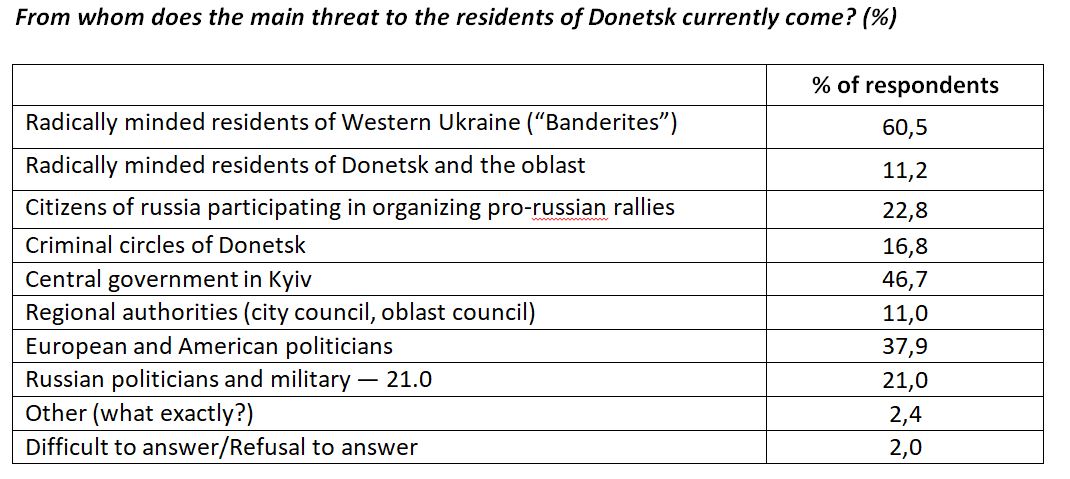
As we can see, all the main “threats” were perceived by the residents of Donetsk as coming from the “Banderites” (residents of Western Ukraine), the central government in Kyiv, and Western politicians. It should be noted that all of them were purely virtual, inspired by russian and local “anti-Maidan” propaganda. But the ground for propagandists was created by our ultra-patriots, who openly insulted the residents of the region, giving russia reasons to “protect” them from the “Banderites”. The threats were imaginary, but they generated real fears.
In reality, it is impossible to find a single example of actions by Kyiv, or especially by Western politicians, that at that moment could have truly threatened the safety of Donetsk residents.
Unless, of course, one considers the war against monuments that began in the capital and the russian language, which was native for most residents of the region. But this is also a very far-fetched “danger”. As the same survey showed, only 3.6% of Donetsk residents at that time supported granting the russian language the status of a second state language. This is within the margin of sociological error.
Moreover, there could not have been any real threats to the residents (not the elite) of the region at that time, given the paralysis of power observed in Kyiv.
As for the “buses with Banderites”, which allegedly set off for Donetsk and provoked the first seizure of the regional state administration, they existed only in the fevered imagination of the secretary of the Donetsk City Council, Serhii Bohachov. It was he who spread this false information in March 2014. Subsequently, in the same 2014, he fled to moscow. Although for several more years he continued to receive a salary from a Ukrainian state university as its professor. Now he is a professor at the Financial University under the government of the russian Federation — the “motherland” appreciated his input.
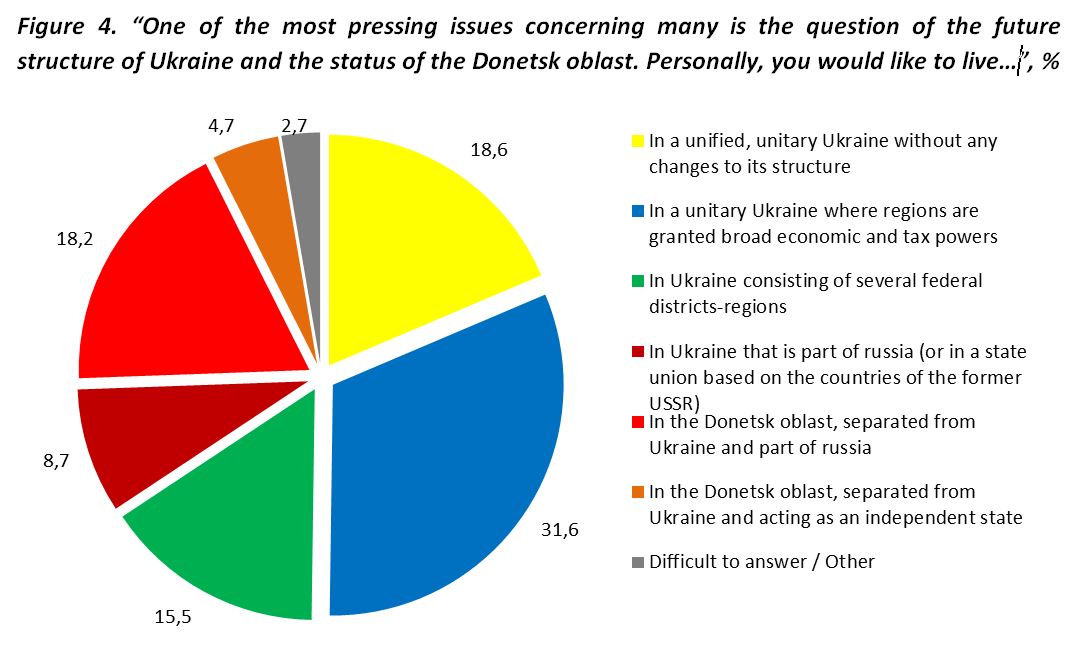
There is really nothing to comment on here. This chart clearly answers the question of whether the residents of the million-strong Donetsk were pro-russian in 2014. It also shows their attitude toward the “state independence” of the “DNR”, which a month later was proclaimed on their behalf by russian political strategists and a handful of local marginal figures.
At the same time, note that the sociological survey was conducted after the “referendum” in Crimea and the annexation of the peninsula by russia. At that time, many expected that a windfall would immediately fall upon the residents of Crimea, so Donetsk residents could also have been tempted by the same prospect. But no — supporters of joining russia in the city amounted to only roughly one-fifth of the population.
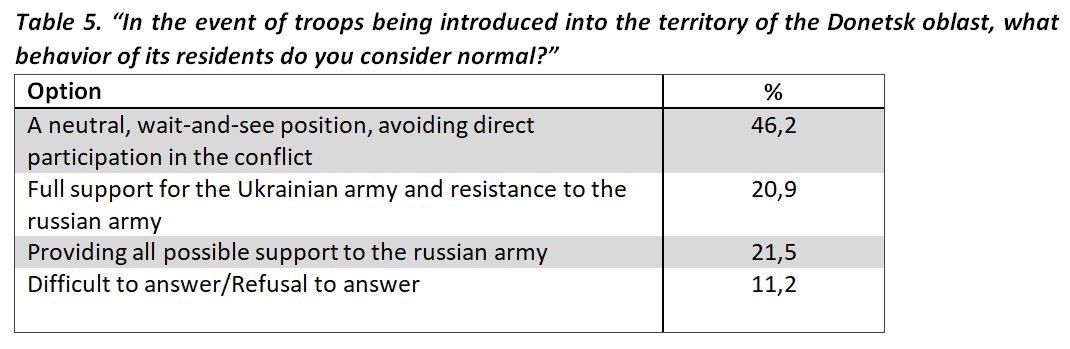
When I wrote that we were shocked by the results, I meant precisely table 5. At the time, my colleagues felt that 21% ready to support the russian army and 20% intending to actively resist it was an indicator of insufficient patriotism in the region. I, however, proceeded from a different logic. 20% is only one-fifth of the population. The total number of supporters of pro-russian political parties in Ukraine at that time was higher. In other words, these 20% reflected not a regional specificity, but an all-Ukrainian situation. As did the fact that 46% did not support any radicalism, leaving the situation to be resolved by political elites.
Another important point — 77% of Donetsk residents were against the seizure of administrative buildings and pro-russian rallies taking place in the city. Only 16% supported them. The installation of russian flags on administrative buildings in Donetsk was supported by 24%, while 70% did not support it.
The arrest of the organizers of the unrest was fully supported by 61% of Donetsk residents, and another 19% considered it a correct measure. The deportation from Ukraine of foreign citizens involved in organizing the unrest (i.e. russians) was supported by every second Donetsk resident (49%), and taking into account partial supporters — 70%. Only the same 20%, ready to assist russian troops, opposed such a measure.
I remember how my friend, who was also part of the CPSD, asked me then whether I really believed that we would win and that Donbas would remain Ukrainian. I answered: yes, I believe in that, because that is what people want…
Now I am no longer sure that people’s desires are a key element in shaping political reality. At least not in our virtual world, where “truth” is formed simply by the technical ability to influence people’s emotions through media and social networks…
And one more table (the sociological study itself was much larger). It shows what actually concerned people in the region at the time, and through solving which problems the new authorities in Kyiv could have won their trust.
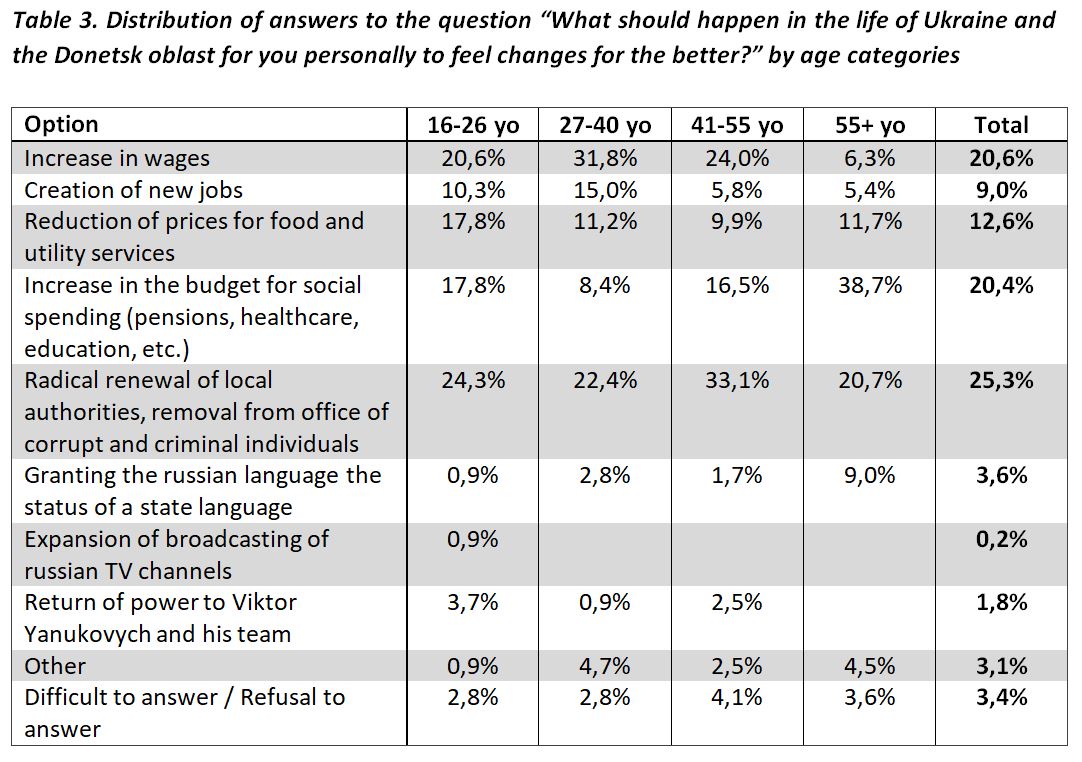
As we can see, neither the russian language nor the overthrow of the “legitimate Yanukovych” were pressing issues for the residents of Donetsk in the spring of 2014. The main causes of social tension in the region were: 1 — fear of the “Banderites”; 2 — corruption and lack of social mobility; 3 — low income levels; 4 — poor social welfare…
I do not think that, except for the first one, this is some kind of unique regional issue for Ukraine. It was precisely these problems that the new authorities needed to address first and across the entire country.
Instead, the new authorities deliberately focused on sensitive irritants for the region, such as language and monuments, as if marking the parameters of a “new order” with political symbols. Because of this, people perceived all innovations as a threat to themselves, as an attempt by the “Banderites” to impose their way of life by force — that is, their domination. Of course, russia fertilized this soil created by our politicians with its PSYOP and far from “polite” “little green men”…
And yet, it was possible to first feed people, calm them down, and only then, without unnecessary politicization, deal with historical, language, and other sensitive issues. But… in Kyiv they were preparing for parliamentary and presidential elections…
After the plan
Poroshenko’s plan for Donbas, announced during his inauguration, was a good one. But when have politicians in our country ever carried out any plans other than those for personal enrichment?
All further actions of the new president regarding the “Poroshenko plan” fit into the logic of Gogol’s character Taras Bulba — “I gave you life, and I will take it away”! First, the involvement of the “bandits” in the implementation of the plan effectively delegitimized it in the eyes of Ukrainians and gave rise to constant suspicions of “betrayal”. Then it turned out that Poroshenko himself, apparently, was not going to follow his own plan, since nothing of what had been promised was implemented in the government-controlled territory. Not to mention his subsequent slide into overt nationalism, alien to many residents of such a multinational region as Donbas.
However, it is possible that when this plan was written, the newly elected president genuinely intended to carry it out. But the logic of his subsequent actions shows that it was planned not to solve people’s problems in Ukraine, but as a concession to putin and a “bridge” to approval from Merkel and Hollande. And that are two very different things.
It is curious that on the same day when the “interested parties” were negotiating in Donetsk with the second President of Ukraine, the Shevchenkivskyi District Court of Kyiv granted the “motion initiated and agreed upon by the Prosecutor General’s Office of Ukraine to authorize the detention of a number of self-proclaimed ‘high-ranking’ leaders of the ‘DNR’ and ‘LNR’ for consideration of the application of a preventive measure in the form of detention”. This was reported on June 23, 2014, by the press service of the Prosecutor General’s Office of Ukraine.
In particular, as noted in the statement, it concerned the “prime minister of the DNR” Borodai, the “chairman of the Security Service of the DNR” Khodakovsky (who at that time, by the way, was still officially listed as the head of the regional Security Service of Ukraine “Alpha” unit), the “vice prime minister for social policy of the DNR” Kaliusky, the “minister of labor and social policy of the DNR” Liagin, the “minister of information and mass communications of the DNR” Khriakov, the “head of the government affairs department of the DNR” Borys Litvinov, the “minister of economic development of the DNR” Podhorny, the “minister of defense of the LNR” Plotnytskyi, the “minister of internal affairs of the LNR” Ivakin, the “chairman of the Central Election Commission of the LNR” Malykhin, the “chairman of the parliament of the LNR” Karyakin.
That is, the Prosecutor General’s Office of Ukraine considered them “bandits”, while Poroshenko — who had promised that “we will not talk to bandits” — did not!
And one more curious detail. Remember how many accusations there were against the OSCE Monitoring Mission because it included russians who attended militants’ weddings and showed other signs of bias? So, on June 23, 2014, the President of Ukraine Petro Poroshenko, during a phone conversation with the Federal Chancellor of Germany Angela Merkel, “reported that he had officially proposed to the russian side to send its inspectors to the OSCE Monitoring Mission in order to certify the full observance of the ceasefire regime from the Ukrainian side”. Such news was published on the official website of the President of Ukraine.
It is unlikely that Petro Poroshenko wanted to harm Ukraine by this. He was probably guided by a naive desire to show putin the sincerity of his intentions. But in fact, it turned out that from the status of a party to the conflict, he himself transferred russia into the status of an observer and mediator, which the OSCE was. And this precisely indicates Poroshenko’s dual attitude toward russia. Apparently, he still could not fully realize that the goal of russia was not to end the unrest, but to use it to destabilize Ukraine and subsequently subordinate it.
By the way, many businessmen who had business ties with russia suffered from this at the time. The fact is that they were used to “solving issues” with it, guided by the business logic of that time: “money beats evil”. Coming out of the semi-criminal circles of the USSR, they simply did not believe that “the capital of their homeland, moscow” could seriously want to just take everything from them. To force them to share, to kill — yes, that was considered possible, but to take everything as if they were nobody at all… This contradicted the very system of post-imperial relations that moscow itself had built in the post-Soviet space. They did not understand that by that time putin had already stopped thinking in business categories. And, as a former KGB officer, he had never thought in their terms either. I think that, having subordinated both the state apparatus, and business, and criminal circles already during his first two presidential terms, he was already looking with contempt at all this “fuss” within russia and in its “historical territories”.
After the easily obtained Crimea, he saw himself exclusively in the context of history and geopolitics — a restorer and autocrat of the russian empire, a “gatherer of russian lands”, a second pole of the world. But the business-political establishment of Ukraine clearly did not yet realize this.
This was also the mistake of the so-called “Donetsk elite”. In the spring of 2014, the “masters of Donbas” were fighting only Yanukovych and Poroshenko, in whom they saw a threat to their property and their capital. Russia, at least until the summer of 2014, they regarded more as an arbitrator-mediator than as a threat… And when the danger coming from moscow was realized, they simply retreated, feeling betrayed but powerless to resist.
My “qualification training”
Being the head of a fairly influential internet publication in Donetsk at the time, and before that (or simultaneously with it) a correspondent for several of the largest all-Ukrainian outlets, I was familiar with and communicated with many official and real “masters” of the region. In early May, in the middle of the night, I received a call from a very respected Donetsk businessman. For the first time in my life, I could tell from his voice that he was drunk. Not everything he said could even be understood. But he was crying (!) out of resentment toward moscow, which “betrayed us”…
In general, of course, the position of the local “elite” during the “russian spring” of 2014 requires a separate discussion. But the roots of the Donbas problem of that period still originated from Kyiv. All the actions and inactions undertaken by local authorities, businesses, law enforcement, etc. in Donetsk were a consequence of the paralysis of the entire state apparatus at that moment.
I call this a crisis of responsibility. Leaders were afraid to take responsibility for decisions that would strengthen the position of the state but could provoke dissatisfaction among the crowd. They were afraid because they did not believe in the state’s ability to protect them. Moreover, they did not trust the state, fearing that they could be made “scapegoats” for lawful but unpopular actions.
And this came from the very top, from the capital. This became especially obvious after the unimpeded seizure of Ukrainian Crimea by russia.
Hence the ambivalent position of mayors, who, even if they did not have pro-russian sentiments, were forced to play along with tricolor crowds, since they could not rely on their police or army.
“Why don’t they resist, after all, according to all laws and regulations they have the right to, up to opening fire?” - I asked at the time a truly patriotic head of one of the law enforcement agencies.
“And in Khmelnytskyi, when the crowd stormed the Security Service of Ukraine and the officers opened fire — didn’t they have that right?”
“They did”.
“But they are being tried! And in other western oblasts how many people are being tried for abuse of power or for obstructing peaceful assemblies?... No, there are no fools to do that. Today you defend the state, and tomorrow it will imprison you for the same thing to please the voters… After all, the seizures of state institutions did not start with us. (During the events of Euromaidan in February 2014, SSU offices in Lviv, Ivano-Frankivsk, Ternopil and Khmelnytskyi were seized — ed.) And experience shows that it is easier to surrender and leave than, God forbid, to kill or wound someone and then go to prison for it. Our authorities change quickly, and what is heroism today is a crime tomorrow. We do not have a state as a system of rules and institutions. Every gang that comes to power believes that it is the state…”
That conversation explained a lot to me at the time: both the military units with arsenals of weapons captured without a single shot; and the inability of the military and law enforcement to defend the Oblast State Administration, the regional SSU Directorate, the Prosecutor’s Office, the treasury…
All of this created chaos in which everyone vested with even a little authority was on their own and solved not the problems of the state, but their own, selfish ones. Moreover, everyone believed that this is how everyone else was acting…
My conversation with a high-ranking police official of the regional Department of Internal Affairs was similar. It was not our first interaction, so there was already a certain level of openness. He suggested to me… eliminating local organizers of the “DNR” using the forces of our Self-Defense unit, which had joined the CPSD. Supposedly, we would be given addresses, routes, we just needed to do it…
And before that — right after the murder of Dmytro Cherniavskyi on March 13 at Lenin Square — this same cop, in all seriousness, told me that the Ukrainian patriot had been killed… by fans of FC Shakhtar, who were part of this Self-Defense.
Therefore, I immediately understood his scheme: you kill them (not all, only the most uncooperative), and then we imprison you for it. Killing two birds with one stone! And as a result — the city is again under Rinat Akhmetov’s rule: only controlled “FSB guys” (as separatists were called at the time) and controlled pro-Ukrainian forces (a group working with SCM) remain — no “Maidan crazies”!
In general, the plan was clear. But I never refuse anything right away — it gives an opportunity to obtain more information. So, after we discussed the “motive and capabilities”, the matter came down to the question of “means”, that is, weapons. And… a high-ranking police official offered to sell us Kalashnikov rifles for $3,000 per unit…
I later asked people competent in this matter, and they told me that this rifle could be bought on the black market for $800… So it was a setup and a scam in one package.
By the way, this is important for understanding the situation. In August 2014, an adviser to the Minister of Internal Affairs of Ukraine, Anton Herashchenko, stated that only 10–15% of police officers loyal to Kyiv remained in the Donetsk oblast. Not all became traitors: “A small part went to fight with the terrorists, while the majority were demoralized and would not be able to continue working in the police”, - Herashchenko explained. In other words, this meant that the “majority” were initially oriented not toward the law or the state, but toward local “masters”, who themselves, as we remember, were “demoralized”…
Another illustration of the chaos that existed in Donetsk in the spring of 2014 is two events that I will briefly combine into one narrative.
A large gathering — in the Donetsk Chamber of Commerce and Industry (the Oblast State Administration building had been seized and trashed by the “rebels”) — a meeting of heads of local self-government, city leaders, and authorities of Donetsk oblast. In many of these very cities and structures, state institutions had already been seized. A whole city, Sloviansk, had already been seized by a detachment of the russian Strelkov… Everyone came to hear what to do. But Governor Taruta stands up and… talks about the need to prepare children’s summer camps for the upcoming season…
There is murmuring in the hall. Some mayors, right from their seats, outline the situation and ask: what should be done? The governor, with a calming smile: “prepare children’s camps”. As if — don’t worry, everything is going according to plan…
I heard about this “plan” many times. But there was also a specific case that later became a kind of meme in Donetsk — “Where is Taruta?!”
This is already April or early May. The Oblast Administration building has long been firmly seized. The office of ISD — the corporation headed by Governor Taruta before his appointment to public office — has also been seized and looted. He himself and his team of closest advisers are based in the “Victoria” hotel, near the Donbas Arena. The situation in the city and oblast is already uncontrollable. I arrive at “Victoria” go up to the governor’s floor and ask one of Taruta’s advisers: is there any understanding of what comes next? Maybe it’s already time to act, instead of preparing summer camps?
He looks at me, smiling: “Don’t worry, everything is going according to plan!” A couple of days later, a group of armed, bearded Chechens with assault rifles arrived at the hotel.
“Where is Taruta?” one of them asked with an accent.
At that time, Taruta and his advisers (either the governor himself was not there, so only his team — I no longer remember the details) were hastily evacuating through the back door. Apparently, within the framework of that very “plan”.
Although I think that a plan really did exist. But most likely, it was not Taruta’s plan, but Akhmetov’s — without whose blessing Taruta would not have become governor. In my view, it consisted of creating a chaos in the region controlled by SCM, which would force the post-Maidan authorities in Kyiv to negotiate with Akhmetov and, accordingly, not touch his business. This same chaos would also allow Akhmetov to become valuable to moscow. Whoever controlled the “rebellious” Donbas was needed by both capitals. Agree, such a “plan” explains much of what was done at the time. And even more — what was NOT done.
But again: the masters of the region misjudged the role of russia in what was happening. They saw a threat from Poroshenko — an oligarch who, under Yushchenko, had already behaved aggressively toward them (the arrest of Akhmetov’s right-hand man, Borys Kolesnikov). They feared that Yanukovych, relying on certain oligarchs from russia (Konstantin Malofeev) and local criminals, might take over the region in order to make himself valuable to the kremlin and Kyiv. But they did not think that putin had a real interest in seizing their sandbox and throwing sand from it into Kyiv’s eyes without any intermediaries.
In general, the paralysis of state institutions in the country, the “controlled chaos” in Donbas, the subversive actions of russia and its agents in the form of Yanukovych and various Armen Horlivskyi (a criminal authority from Horlivka who organized the participation of “athletes” in pro-russian actions)… all of this led to the fact that there was no власть left in the Donetsk oblast. None at all: neither state nor business-mafia. Or rather, it was so fragmented and subjective that it essentially disappeared.
Meanwhile, the power of moscow in the region, fueled by money and personnel from russian special services flooding the city, on the contrary, became the only real one against this background.
However, to those who like to completely blacken the past and paint everyone with the same brush, I always say: one must distinguish between the country and the state, the state and the people, the people and the political regime.
In 2014, the real situation was shaped not only by the actions of the state, but also by the people, ordinary citizens. And the people in Donetsk surprised me greatly at that time. Moreover — they made me feel proud. Of them, and of myself.
The first decision of the CPSD, created after the attack by bandits on a pro-Ukrainian rally and the killing of Dmytro Cherniavskyi there, was a moratorium on public actions. We did many things (published a newspaper, painted Ukrainian flags on poles at night, hung yellow-blue ribbons, held TV broadcasts, helped our military, forced heads of state institutions to display Ukrainian flags), but — no rallies or marches that could again end in deaths!
However, in mid-April the situation changed. This was connected precisely with that very meeting on Donbas in Geneva on April 17, which I wrote about above. Members of the coalition decided that it was extremely important on the day of that summit to show the whole world that Donetsk was not only separatists, but also Ukrainian patriots. The rally was planned not just to demonstrate our political views, but as an attempt to help our delegation in Geneva and to remind the world about us — pro-Ukrainian residents of Donetsk, whom even then neither Kyiv nor other capitals were trying to notice. It was obvious that such an event would attract global media. In general — the goal justified the risks.
However, not everyone liked our decision. The city council refused us a location on the central square of Donetsk, where pro-Ukrainian actions had taken place before. This was understandable, since part of the square was already occupied by agents of russia, and it would inevitably have led to clashes.
Our attempt to hold the event in Shcherbakov Park (the central park of the city) was met with a refusal from the park administration under the pretext of repair works. This later found its explanation when the park director Martynov became the “acting mayor” of Donetsk after its capture by the russian terrorist Strelkov.
In general, the leadership of Donetsk, out of a supposed concern for the safety of citizens, effectively began to obstruct us. Then I decided to politicize this issue, and the CPSD sent invitations to participate in the “For Ukraine” rally to all presidential candidates (the election campaign had already begun). This fact, as well as our intention to hold a mass pro-Ukrainian action in Donetsk (after a month-long moratorium), was widely publicized. In general, we just informed everyone about the fact. As a result (or for other reasons), Governor Taruta supported us.
However, the issue of safety still remained open. Of course, I understood that the regional leadership would do everything to protect the potential participants of the rally — the presidential candidates (that’s why we invited them), but I no longer really believed in its ability to do this effectively. Therefore, we spread a rumor that the rally was being held specifically to lure pro-russian militants (who would obviously want to stage another clash there) out of the seized regional state administration building. Allegedly, when they moved toward the rally, internal troops would storm the building and take it back.
The governor held a meeting of all regional security forces, where the plan was discussed and safety measures were outlined. At the same time, it was decided to demonstratively involve the internal troops stationed in the city and march them near the regional administration building before the rally.
The support of Governor Taruta was very significant. However, not everything was so simple. A few days before the event, intense moral and psychological pressure began on me and the CPSD members. At night, unknown people called me and hissed: “you are leading people to slaughter. Their blood will be on your conscience”. Some Committee members, especially women, couldn’t handle it — they began demanding that the event be canceled, sometimes breaking down in tears. The pressure targeted not only us as organizers, but also potential participants of the rally. For several days, a scrolling message ran on local television in which the Donetsk city council and the Ministry of Internal Affairs urged residents not to attend the rally “due to a threat to their lives”…
Living with the awareness that responsibility for people’s deaths could fall on you… It wasn’t enough that I was already sleeping only 4–6 hours a day — now this as well. Those days were my personal hell. It was especially hard because some CPSD members were demanding the rally be canceled. That forced me to truly take personal responsibility and make a decisive choice. In short, the pressure came from both outside and within.
But, as they say, its organizers overdid it. At some point in that extreme tension, I had a realization: I am not leading anyone anywhere! People are not sheep to be driven! They decide for themselves whether to go or not! Thanks to the city authorities, they now knew the risks they were facing and would make a conscious decision. It was their choice! Their position! Who was I to deprive them of the opportunity to act on their decision, to express their stance?!
In general, the “For Ukraine” rally did take place. In the presence of a huge number of Western journalists and film crews. About two thousand residents of Donetsk came. No one was beaten. At least at the rally itself (there were incidents when people were already dispersing and heading home). Thousands of people came under the largest yellow-blue banner in Ukraine, fully aware that they could be killed for it. And they came anyway! Perhaps for the first time that year, I felt proud of my fellow countrymen. Looking at them from the stage, I thought that all of this was not just political fuss, that people like them were worth fighting for…
Later, some even pro-Ukrainian activists said that there was no violence because the rally had supposedly been organized by Akhmetov, and that I was “Akhmetov’s man”… If only they knew what a combination of intrigue, bluff, and provocations I had to play out to make it happen—and to make it happen without bloodshed. By the way, unlike many others, I stood on the rally stage without a bulletproof vest. On equal terms, so to speak.
Here it should be noted that what the CPSD was doing at the time was politics. And politics is not about charging at windmills with an open visor. It is about the necessity of finding resourceful allies, the art of not becoming dependent on them, the ability not to activate potential enemies, and the skill of keeping friends and allies around your goal. In other words — pragmatism, a lot of bluff, and manipulation.
And also — disappointment. In those who could have become friends and allies, could have helped the common cause, but stepped aside due to ambition or unwillingness to accept reality.
I remember my meeting in Donetsk with two journalists representing one of the Donetsk Maidan groups. Even though we hadn’t communicated for a long time before that, I sincerely considered them friends and hoped they would join the CPSD. However, their behavior was cautious.
“Why do you write in the CPSD Manifesto: ‘We, the russian-speaking residents of Donbas’?”
“Well, because we really are russian-speaking. And to declare to the whole world that we do not need to be ‘protected’, no one is oppressing us except russia itself.”
“No, that doesn’t suit us”, - they replied in russian and left…
At the same time, I am sure they are decent and good people. It’s just that nationalists rarely accept reality and love their homeland as it is. They love an ideal, a mythical past, or an imagined future. Therefore, for the sake of something that does not yet exist, that has already died, or has not yet been born, they are ready to sacrifice justice toward the living…
That was the story of my “qualification training” for the Minsk process.
By Serhii Harmash, editor-in-chief of OstroV