
The Dayton Accords: how an “imperfect peace” stopped the war… and froze the conflict
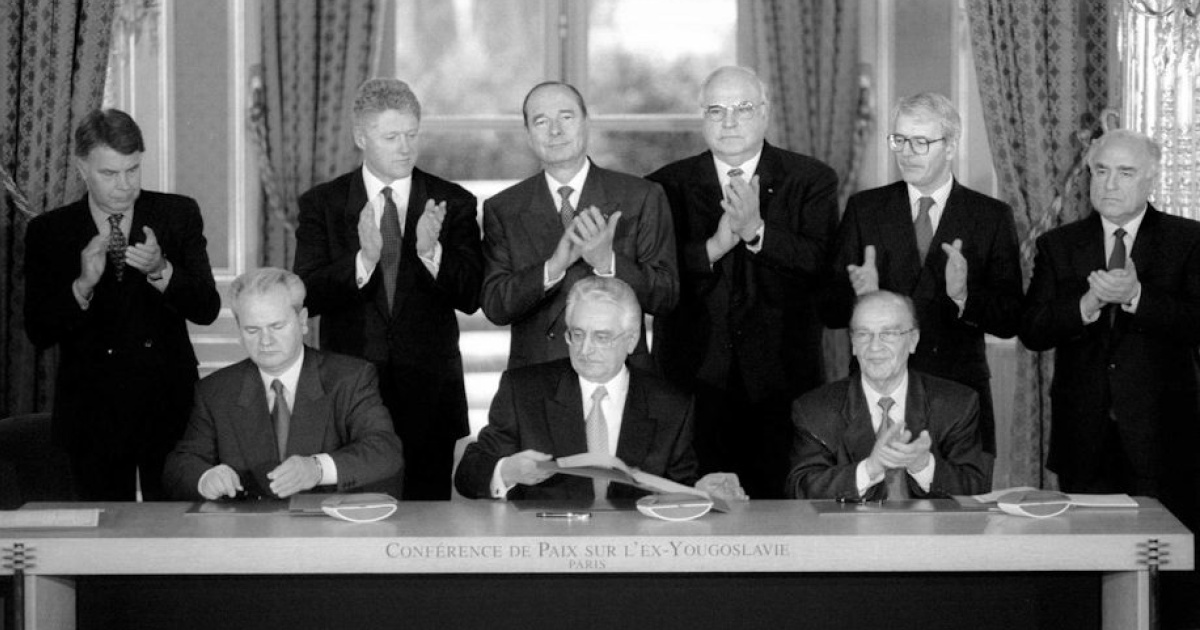
The appearance in the media of information about the intention of the United States to reach a peace agreement between Ukraine and russia by May 15, moreover effectively confirmed by President Volodymyr Zelensky, evokes certain analogies with the Dayton peace agreement on Yugoslavia. Those are dangerous analogies…
The Dayton Accords, signed on December 14, 1995, are often cited as an example of successful international mediation. They did indeed put an end to the war in Bosnia and Herzegovina. However, 30 years later it is becoming obvious: the peace achieved in Dayton did not resolve the conflict, it institutionalized it. This experience is especially important for Ukraine amid discussions about possible formats for ending the war.
A bloody civil war…
The war began after the authorities of Bosnia and Herzegovina announced a referendum on independence in February 1992, at a time when Slovenia and Croatia had already separated from the former socialist Yugoslavia. However, the Serbs, who made up almost a third of the population of Bosnia and Herzegovina, boycotted the vote and refused to recognize its outcome. They announced the creation of their own independent Republika Srpska, which was supported by the authorities of Serbia led by President Slobodan Milošević.
It must be said that Milošević treated Bosnia the same way putin treats Ukraine. He believed that this republic had no right whatsoever to exist as an independent state, dreamed of occupying it or, at the very least, dividing its territory between Serbia and Croatia.
The Bosnian war was extremely brutal. Initially, the Serbs had the advantage in manpower and weaponry, but fairly quickly Bosnian Muslims and Croats managed to restore a balance of forces. Bosnia was actively supported by the Islamic world, which Alija Izetbegović appealed to, as well as by the Croats.
The fighting largely consisted of indiscriminate shelling of cities and villages, and genocide of the civilian population. All sides to the conflict, without exception, were involved in this. Attempts by the UN to stop the massacres by creating “safe zones” protected by peacekeepers were not always successful. It was the Bosnian war that “gave birth” to the term “ethnic cleansing”. It is generally acknowledged that both sides in that war committed horrific war crimes. However, postwar analysis showed that 82% of civilian victims were ethnic Bosnian Muslims. Thus, in 1995 Bosnian Serb forces killed 8,000 Bosnian men and boys in the mining town of Srebrenica. This crime is considered the most egregious large-scale act of genocide in Europe since the end of World War II.
The finale of the Bosnian war were the Dayton Accords on ending the war. They were “born” at a U.S. air base on November 21. At that time, the presidents of Bosnia and Herzegovina Alija Izetbegović, Croatia – Franjo Tuđman, and Serbia – Slobodan Milošević initialed the General Framework Agreement for Peace in Bosnia and Herzegovina. The official conclusion of the peace treaty, which proclaimed the complete end of the bloody war, took place on December 14, 1995 in Paris.
The Dayton peace’s parallels with Ukraine…
The logic of the peace process in Bosnia provided for taking into account the interests of the opposing sides. In fact, Western democracies agreed with the results of the ethnic cleansing carried out by the Serbs. On the territory from which Muslims and Croats had been expelled, Republika Srpska was proclaimed. Milošević also made concessions, allowing Sarajevo to remain under the control of the Federation of Bosnia and Herzegovina and agreeing to leave the strategic city of Brčko neutral (under an international mandate). Muslims and Croats reached an agreement among themselves and created a joint federation. This Federation entered into a single state together with Republika Srpska, effectively splitting the country in half.
As a result of the negotiations, the Bosnian delegation turned out to be the most uncompromising and inflexible, for a long time refusing to yield to Milošević’s proposals, and only the threat by the United States to withdraw from the talks forced it to make concessions.
After the signing of the peace agreement, the first president of Bosnia and Herzegovina, Alija Izetbegović, openly spoke about an insoluble dilemma for his country – the impossibility of achieving a just peace and the impossibility of securing better results on the battlefield. As some experts note, Ukraine today is facing something very similar: it is forced to choose between an imperfect peace and continuing the struggle, with the risk of ending up with an even worse agreement.
The decisive role in signing the Dayton Accords was played by the United States of America. It was they who assumed diplomatic leadership of the process. For President Bill Clinton, the main motivating factor was the desire to achieve a foreign policy success before the 1996 elections. And in this respect he is not very different from the current president Donald Trump, who is trying to end the war in Ukraine more quickly in order to gain not only the Nobel Peace Prize, but also electoral dividends ahead of the midterm congressional elections in November 2026.
U.S. approaches to “forcing peace” have changed little over thirty years. Just like back then, Washington wanted to stop the war with both carrot and stick. The U.S. president’s special envoy – Richard Holbrooke – using shuttle diplomacy, traveled between Belgrade, Sarajevo and Zagreb, persuading regional leaders to end the war, threatening sanctions and the loss of American support.
Drawing parallels between the Dayton Accords and Trump’s “peace plan” for Ukraine, other common features can also be seen. First, Donald Trump likewise wants to “quickly stop the war at any cost”. He is seeking a ceasefire regardless of how painful and humiliating the peace terms may be for Ukraine, completely forgetting who in this war is the victim and who is the aggressor.
Second, the Trump–Witkoff communication with putin also resembles Holbrooke’s negotiations with Milošević. On the one hand, he promises to lift sanctions in exchange for ending hostilities, and on the other threatens increased military aid to Ukraine. Holbrooke also spoke to Milošević about lifting sanctions, while at the same time arranging bombings of Bosnian Serbs. Third, the similarity between the Dayton Accords and Trump’s “peace plan” lies in the proposal of territorial concessions as part of the deal. Back then, Republika Srpska’s acquisition of new territories through ethnic cleansing became Dayton’s disgrace. Today, Trump’s demand for territorial concessions from President Zelensky looks not like a peace plan, but like a plan for Ukraine’s capitulation. Fourth, just as 30 years ago, the Americans have pushed Europeans out of the negotiations.
Trump deliberately removes them “from the game” in order to strike a deal favorable to moscow, convenient for himself, while also weakening the European Union as a political player.
The heavy legacy of Dayton…
Thirty years after the signing of the Dayton Accords, Bosnia still lives with borders agreed upon by three presidents. At the time, it was believed that Dayton’s main provisions were a one-year roadmap, to be followed by a new agreement. However, politicians were never able to agree on anything, leaving citizens now living in Bosnia and Herzegovina with a complex political structure that could “tear” the country apart at any moment.
Another echo of Dayton is the establishment of the political post of High Representative for Bosnia and Herzegovina – an international official tasked with ensuring compliance with the 1995 peace agreement – a clear analogy to Trump’s “Board of Peace”.
The very fact of its existence three decades later is a direct acknowledgment that:
- the system created by the Dayton Accords is incapable of functioning independently;
- without an external arbiter, the country risks returning to paralysis of power and conflict.
What this experience means for Ukraine
The Dayton experience demonstrates several fundamental points:
1. A rapid ceasefire does not equal sustainable peace. In Bosnia, the war ended, but the conflict remained embedded in the political system.
2. Territorial compromises without societal reintegration create long-term instability. Dividing the country along the front line became a source of permanent crisis.
3. External mediators act based on their own political goals. For the United States in 1995, the priority was ending the war, not the future of Bosnian statehood.
4. An “imperfect peace” tends to become permanent. What was conceived as a temporary solution turned into a rigid framework for decades.
Instead of a conclusion
The Dayton Accords stopped the war, but did not bring Bosnia political integrity or sustainable development. For Ukraine, this experience matters not as a model to copy, but as a warning about the price of compromises concluded under pressure and without a clear understanding of what the state will look like “after peace”.
By Ihor Oleksienko, for OstroV